
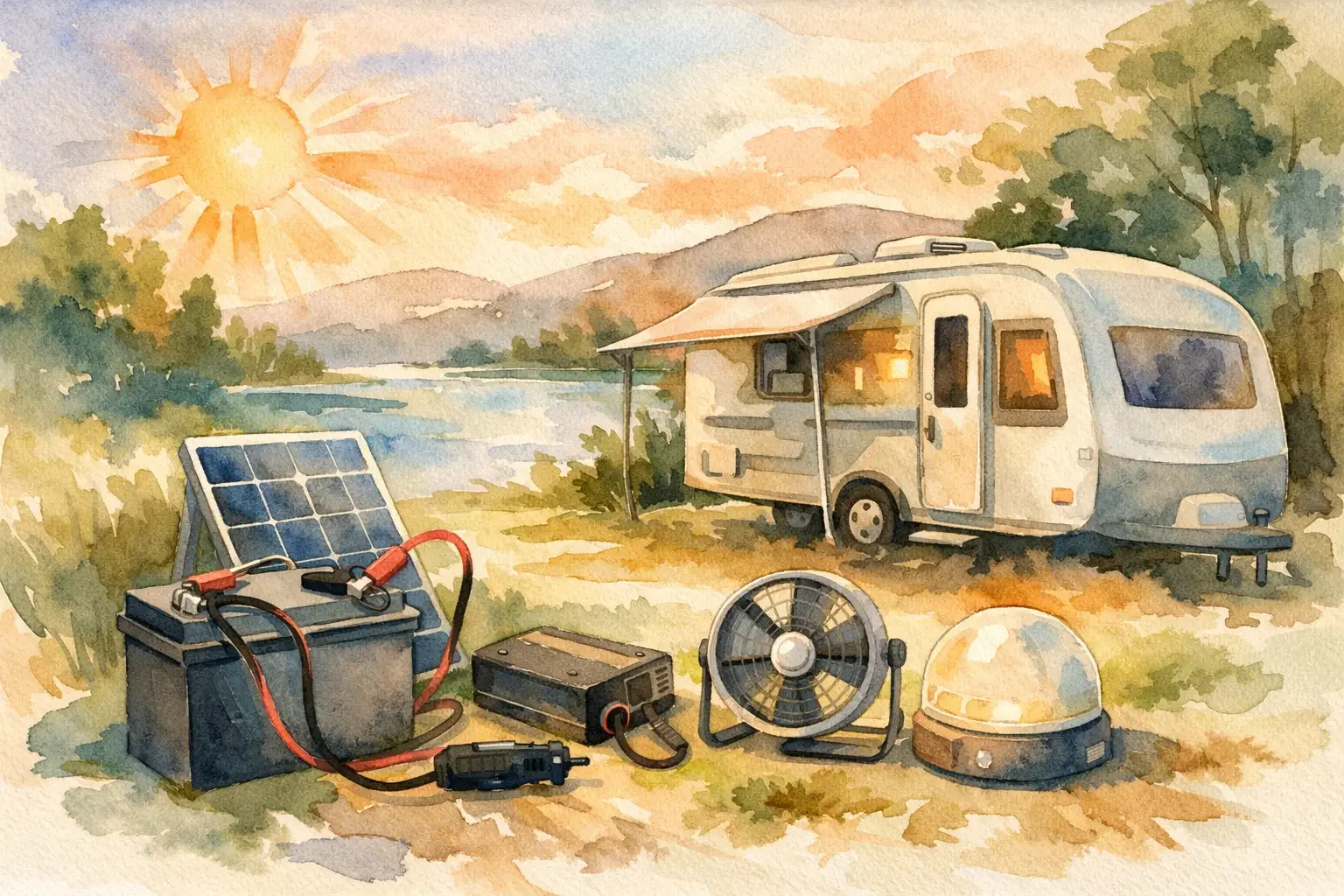
Caravan 12 Volt Basics Made Simple
If your caravan electrics feel slightly mysterious, you are not alone. For plenty of owners, the 12V side is where confidence quietly evaporates - especially when a light flickers, the pump goes silent, or the battery seems to sulk for no obvious reason. The good news is that caravan 12 volt basics are much simpler than the horror stories make out.
Think of 12V as your caravan’s low-voltage everyday power system. It runs the practical bits that need to work whether you are plugged into mains or not, such as lights, the water pump, control panels, fans and often things like USB sockets. In most caravans, it is supplied by the leisure battery, with help from the onboard charger when you are connected to 230V on site.
What the 12V system actually does
The easiest way to understand it is to separate your caravan into two electrical worlds. There is the 230V mains side for sockets and mains appliances, and there is the 12V side for core caravan functions. If that distinction still feels a bit foggy, this guide on Caravan 12V vs 230V Explained fills in the gaps nicely.
Your 12V system is less about luxury and more about basic usability. No 12V, and suddenly simple jobs become awkward. You may lose lighting, pump operation, the control panel, the flush on some toilets, motor movers in many cases, and other small but important functions. That is why a flat battery can make a caravan feel far more broken than it really is.
The three parts worth understanding
You do not need to become an auto electrician. You just need a clear picture of the main players.
The leisure battery stores power. That is your reserve when you are not hooked up, and it also helps smooth things out when you are. Batteries are consumable items, not magical boxes of forever. Age, poor charging, winter neglect and repeated deep discharging all shorten their life.
The charger or power supply unit converts 230V mains into usable 12V and, in most caravans, charges the battery at the same time. When you are on hook-up, many 12V services are being supported by this unit, not purely by the battery.
Then you have the 12V circuits themselves - lights, pump, fans, controls and so on. Each circuit is protected by a fuse. If one thing stops working but everything else is fine, a fuse is often the first sensible check, not the beginning of a dramatic electrical detective series.
Caravan 12 volt basics that catch beginners out
One common misunderstanding is assuming the battery does everything all the time. It does not. On hook-up, the charger usually carries much of the load and may top up the battery as well. Off-grid, the battery becomes far more important, and your habits matter. Leaving lights on, running pumps unnecessarily, charging devices constantly and expecting a tired old battery to cope cheerfully is optimistic in the way only caravanning can be.
Another issue is assuming a battery is healthy just because something still works. A battery can be weak enough to cause odd behaviour long before it is properly dead. Dimming lights, a pump that sounds laboured, or a mover that struggles can all point to low voltage rather than a major fault.
If your battery keeps losing charge, the cause is usually mundane rather than sinister - age, poor charging, parasitic drain, or simply expecting too much from too little. This is covered in more detail in Why Your Caravan Battery Keeps Going Flat.
How to think about faults without the panic
Most 12V problems come down to one of four things: no charge in the battery, a blown fuse, a poor connection, or a charger issue. That does not make them fun, but it does make them more manageable.
Start by asking a boring question first: is the caravan on hook-up, and is the charger actually on? It sounds obvious, right up until it is the answer. Then check whether the problem affects everything or just one item. If all 12V systems are unhappy, think battery, charger or main fuse. If just the pump or one light circuit has failed, think local fuse or connection.
This is also where restraint helps. You do not need to dismantle half the caravan because one LED strip has gone moody. Calm, simple checks beat random button pressing every time.
For that reason, it helps to know where your fuses are and what they protect. If that subject normally induces instant boredom, Caravan Fuses Explained Without the Fa makes it far less painful than it sounds.
Do you need to upgrade anything?
Maybe, maybe not. A lot of people buy extra electrical kit before they understand the system they already have. That usually leads to a lighter wallet and not much extra confidence.
If you mainly stay on serviced pitches, a decent battery in good condition may be all you need. If you tour off-grid more often, then battery capacity, charging setup and usage habits matter much more. Lithium batteries are increasingly popular, but they are not compulsory, nor are they the answer to every electrical annoyance. Better understanding often solves more than better shopping.
A sensible baseline for every owner
If you know where the battery is, where the charger lives, where the 12V fuses are, and how to tell whether the caravan is actually charging, you are already ahead of the game. Add a habit of checking battery condition before trips and you remove a surprising amount of avoidable stress.
That is really the heart of caravan 12 volt basics. It is not about becoming obsessed with volts, amps and gadgets. It is about knowing enough to spot the difference between a normal issue, a tired battery and a fault that genuinely needs attention - which is a much better place to be than standing on a pitch poking switches and hoping for divine intervention.
A Better Caravan Community
TalkWrench is a calmer place where caravanners share real experience without the shouting matches. Practical answers, friendly people, no drama.