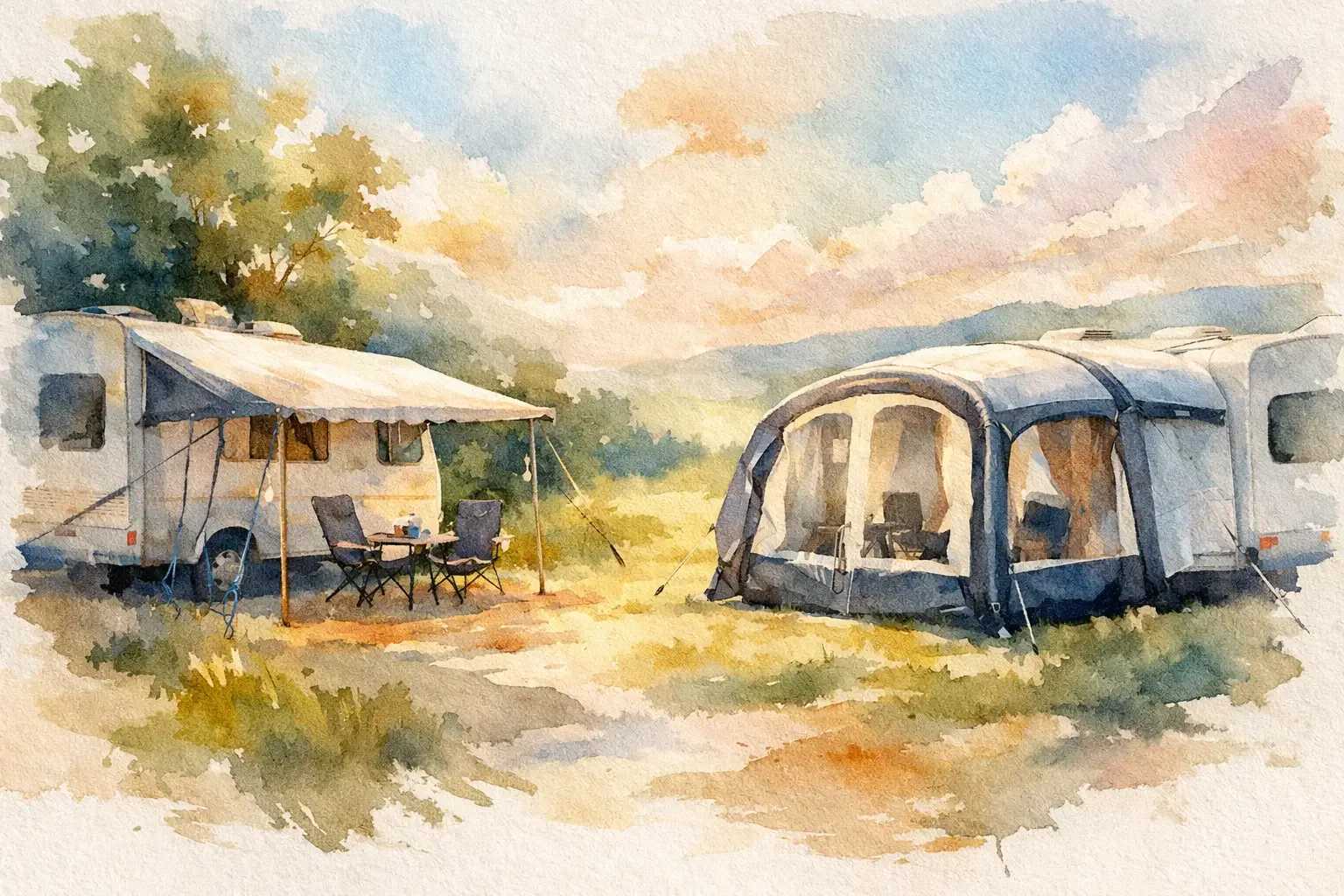
Caravan Awning vs Air Awning: Which Suits You?
If you have ever stood on a pitch watching someone wrestle poles in a crosswind while another person calmly pumps up an awning in ten minutes, the caravan awning vs air awning debate starts to feel very real. This is not one of those topics where there is a single correct answer handed down from the caravanning gods. It depends on how you tour, how patient you are after arrival, and how much faff you are willing to tolerate before the kettle goes on.
Caravan awning vs air awning: the real difference
At the simplest level, a traditional caravan awning uses poles to create its structure. Those poles might be steel, aluminium, or lightweight composite, and they form the frame that supports the fabric.
An air awning replaces most or all of that frame with inflatable beams. Instead of feeding poles together and tensioning them into place, you slide the awning into the rail, peg it roughly into position, and inflate the main structure with a pump.
That sounds like an easy win for air awnings, and for many people it is. But easier does not always mean better in every situation. Traditional awnings still have a lot going for them, especially if you stay put for longer periods or want a more rigid, planted feel once everything is set up properly.

Setup time and effort
This is usually the first reason people start looking at air awnings. Pole awnings can be perfectly manageable, but they ask more from you. There is more sorting, more assembly, and usually a greater chance of muttering things under your breath while trying to work out which pole goes where.
For solo caravanners, couples where one person ends up doing most of the setup, or anyone with back or shoulder issues, an air awning can be a very sensible choice. Once you get the hang of it, the process is straightforward. You still need to peg it properly and tension it well, but the actual structure goes up with far less heaving and juggling.
That said, traditional awnings are not impossible relics from a more miserable age. If you use the same one regularly, label your poles, and develop a routine, setup becomes much less dramatic. Plenty of caravanners can put up a pole awning efficiently because they know their kit and take a methodical approach.
If your touring style is frequent short breaks, an air awning often makes more sense. If you pitch for a week or two and do not mind spending longer setting up on day one, a traditional awning still deserves a fair hearing.
Weight, packing and storage
Here is where things get a bit less tidy. People sometimes assume an air awning is automatically lighter because it has no metal frame. Not always.
Inflatable beams can be bulky and surprisingly heavy, especially on full-size awnings. A traditional awning with lightweight poles may spread its weight across separate bags, which some people find easier to lift and stow. An air awning may come in one large bag that feels determined to test your back and your good mood.
For anyone already watching payload carefully, the actual packed weight matters more than marketing language. Check the real numbers before buying, particularly if your caravan payload is modest and your tow car is already carrying half the holiday.
Storage matters too. A bulky air awning bag can be awkward in a front locker or car boot, while a pole awning may be easier to split into manageable parts. Neither is automatically the better option here. It comes down to your van, your car, and how much lifting you are happy to do.
Stability in wind and weather
This is where opinions become strangely tribal. Traditional awning fans will tell you poles are sturdier. Air awning fans will tell you inflatable beams flex rather than bend, which can be an advantage in gusty conditions. Both have a point.
A well-pitched traditional awning can feel very solid. Once tensioned correctly, it often gives a reassuringly rigid structure. For seasonal use or longer stays, that planted feel is one reason many owners still prefer them.
A well-made air awning, pegged and guyed properly, can also cope very well with poor weather. Because the beams have some give, they can absorb movement rather than transferring stress into a rigid frame. What matters most is not whether it has air tubes or poles. It is whether it is pitched correctly, suited to the conditions, and not being used as a giant sail because someone got lazy with the guylines.
In proper foul weather, neither type should be treated casually. Storm straps, sensible pitching, and occasionally admitting that the weather is winning are all part of caravanning. Pride is rarely waterproof.
Cost and long-term value
Air awnings are often more expensive at the point of purchase, especially from the better-known brands. You are paying for convenience and design, and in many cases that convenience is worth it.
Traditional awnings can offer good value, particularly if you want a full awning with lots of space without spending a small fortune. They also tend to have fewer specialist components. If a pole is damaged, replacement can be relatively straightforward. With an air awning, punctures and valve issues are repairable, but they can feel more daunting if you are not confident with maintenance.
This is one of those areas where honesty helps. If a faster, easier setup means you will actually use the awning regularly, paying more may be sensible. Buying a cheaper pole awning that lives in the garage because you dread putting it up is not really a bargain.
Space and how you actually use it
Not all awnings are trying to do the same job. Some people want somewhere to kick off muddy shoes, dry the dog, and stop the caravan door opening straight into the weather. Others want a full extra living space with room for chairs, storage, and the sort of family clutter that appears by day two.
Air awnings are especially popular in porch-awning sizes because they suit quick trips and simple setups. They are ideal for weekends, overnight stops, and touring holidays where you move on regularly.
Traditional awnings still make a lot of sense if you want a larger full awning for longer stays. The structure can feel more conventional and, for some layouts, more usable over extended periods. There are also full-size air awnings, of course, but they can be expensive, heavy, and rather substantial to handle when packed away.
So the question is not just caravan awning vs air awning. It is also porch vs full awning, short stays vs longer stays, and quick shelter vs extra living room.
Maintenance and repairs
Neither type is maintenance-free, because fabric left damp, filthy, or badly stored will eventually complain.
Traditional awnings need the usual checks for bent poles, worn fittings, and tears in the fabric. Their advantage is simplicity. You can often see the problem, identify the part, and sort it.
Air awnings are not fragile little balloons waiting to let you down at teatime. Most are tougher than sceptics assume. But punctures can happen, valves can develop faults, and tube access varies by design. Repairs are usually manageable, though they may feel less familiar to owners who are happier with metal poles than inflatable structures.
If you like straightforward mechanics and easily understood parts, a traditional awning may appeal. If you value ease of use and are happy to learn a slightly different maintenance routine, an air awning should not scare you off.
Which one suits your touring style?
Choose a traditional caravan awning if...
You tend to stay on one site for longer stretches, want the most rigid feel, or would rather spend less upfront. It also suits caravanners who do not mind setup taking a bit longer and prefer a more conventional structure.
Choose an air awning if...
You move around frequently, want less setup effort, or need something more manageable physically. It is especially appealing for newer caravanners who want fewer steps and less scope for setup becoming a full-scale domestic negotiation.
There is also a middle ground. Some owners keep a porch air awning for touring and skip the idea of a full awning altogether. Others start with a traditional awning that came with the caravan, then switch later once they know how they actually holiday. That is often the most sensible route. Experience clears up what internet arguments never will.
The mistake to avoid
The biggest mistake is buying based on somebody else's certainty. Caravanning attracts strong opinions, often delivered with the confidence of a man explaining that there is only one proper way to make tea. But your best option depends on your body, your budget, your storage space, your patience, and how you travel.
If possible, see both types in person. Watch them being put up. Better still, ask honest questions about what they are like at the end of a wet trip when everything needs drying at home. That tends to produce more useful answers than showroom perfection.
At CaravanVlogger, the most useful approach is usually the least dramatic one: match the kit to the job. If you want quick, frequent, low-fuss touring, an air awning is often the better fit. If you want maximum space, lower purchase cost, and a structure that suits longer stays, a traditional caravan awning may suit you better.
The right awning is the one that makes you more likely to enjoy the trip, not the one that wins an argument on a forum. Choose the option that makes arrival on site feel easier, calmer, and one step closer to putting the kettle on.