
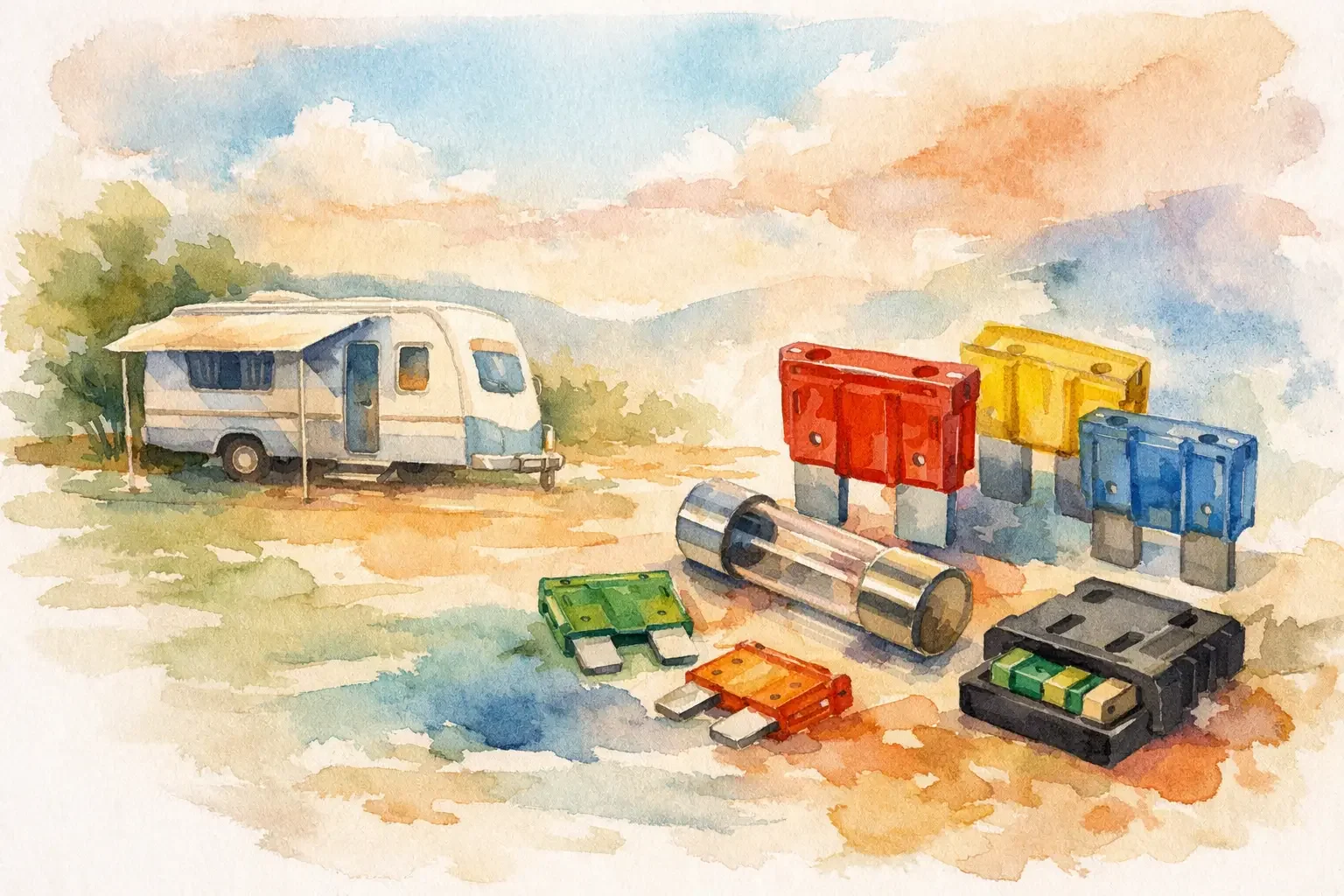
Caravan Fuses Explained
A blown fuse has a special talent for making a caravan feel far more dramatic than it really is. One minute the lights work, the pump runs and everything feels civilised. The next, half the van appears to have given up on life.
Most of the time, though, a fuse is not a mystery and it is not the caravan plotting against you. It is simply doing its job.
Caravan fuses explained simply
A fuse is there to protect wiring and equipment by breaking the circuit if too much current flows. In plain English, it is the sacrificial bit. Better to lose a small, cheap fuse than damage a control unit, melt wiring or create a proper fault.
That matters because caravans usually have more than one electrical system at work. There is the 12V side for things like lighting, pumps and some control panels, and the 230V side for mains-powered circuits when you are plugged into hook-up. If that distinction still feels a bit foggy, Caravan 12V vs 230V Explained will make the rest of this topic easier.
You may also have fuses built into individual appliances, fuses in the main power supply unit, and breakers or RCD protection on the mains side. So when someone says, "check the fuse", they are not wrong, but they are often being a bit optimistic about how many there might be.
Where caravan fuses are usually found
In most UK caravans, the main 12V fuses are grouped in the power supply unit, often in a cupboard, under a seat box, or near the leisure battery area. They are commonly blade fuses, much like the ones used in cars.
The 230V system is different. Instead of little coloured blade fuses, you are more likely to see miniature circuit breakers and an RCD in a consumer unit. These are not interchangeable with 12V fuses, and treating them as if they are all basically the same thing is where confusion starts.
Some appliances may also have their own inline fuse or small fuse on a circuit board. Water pumps, motor movers, fridges and heating systems can all bring their own little plot twists. If your heating is the only thing playing up, Caravan Heating Explained Properly may help you work out whether you have a power issue or a heating-specific one.
Why caravan fuses blow
Usually, a fuse blows for one of three reasons. There is a genuine fault, there is a temporary overload, or someone has fitted the wrong fuse previously and created tomorrow's problem yesterday.
A fault could be a short circuit, damaged wire, water ingress, a failed appliance or a trapped cable. An overload is simpler - too much current is being drawn on that circuit. That can happen if equipment develops a fault or if accessories have been added badly.
Then there is the classic bodge: replacing a blown fuse with one of a higher rating "just to get going". Please do not. That is how you turn a cheap warning sign into an expensive repair. The fuse rating is chosen to protect the circuit, not to test your optimism.
How to tell which fuse has failed
Start with the symptom, not random fuse pulling. If all 12V systems are dead, check the main supply, battery connections and the main fuse near the power unit or battery. If just one thing has stopped working - say the water pump or a single lighting circuit - look for the labelled fuse for that circuit first.
Many power units have a diagram or label beside the fuse bank. If yours does not, the handbook is useful for once. If a fuse looks broken, blackened or the metal strip has snapped, that is a fair clue. But some failed fuses are less obvious, so a continuity tester or multimeter is more reliable.
If your battery-related systems keep behaving oddly, it is also worth reading Why Your Caravan Battery Keeps Going Flat, because low voltage and fuse faults can sometimes get muddled together.
Replacing a caravan fuse safely
Turn off the relevant power source first. For 12V circuits, isolate the battery and charger if needed. For 230V, disconnect hook-up before touching anything around the mains consumer unit. If you are unsure what you are isolating, stop there and check the handbook.
Replace the fuse with the same type and same rating. Not "close enough". The same. Blade fuses are colour-coded, which helps, but always read the number stamped on top rather than trusting your memory after a long drive and a cup of tea.
If the new fuse blows immediately, that is useful information. Annoying, yes, but useful. It suggests an active fault rather than a one-off blip. Replacing it repeatedly will not cure anything, rather like pressing a lift button harder does not make it arrive faster.
When it is not a DIY job
If the fault is on the 230V side, if there are signs of heat damage, if wiring has clearly been modified, or if the same fuse keeps blowing without an obvious cause, it is time for a competent technician. Sensible caution is not overreaction.
The same applies if you smell burning, find melted insulation, or have intermittent electrical faults that come and go. Those are the sort of problems worth diagnosing properly, not guessing at in a campsite awning while pretending you always meant to spend the afternoon fault-finding.
A small pack of spare correctly rated fuses is worth carrying, because they are cheap, light and often save a lot of head-scratching. Just make sure they are spares, not a substitute for fixing the reason one blew in the first place.
Where Next?
Prepare Your Caravan or The New Season is part of the “Caravan Ownership - What Really Matters” guide on CaravanVlogger.
Or….
Need clearer caravan answers?
TalkWrench is where caravan questions get calm, experience-based explanations — without the noise, arguments, or guesswork.