
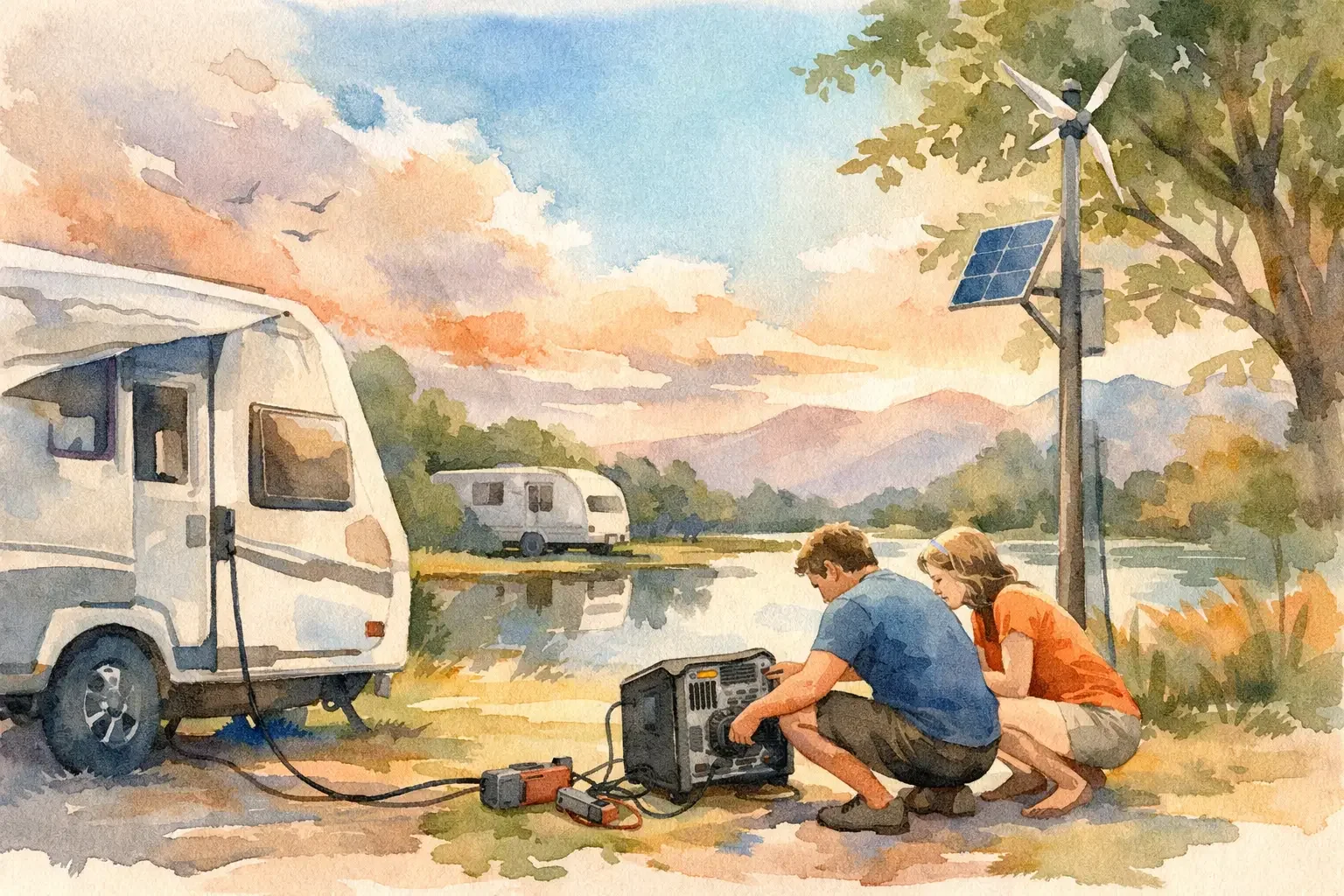
Caravan Power Problems Without the Panic
Power issues in a caravan have a special talent for showing up at the worst possible moment. Usually just as the kettle is about to go on, the lights go dim, or the heating decides it has had enough of your nonsense.
The good news is that most caravan power problems are not mysterious, and they are not always expensive. Quite often, they come down to a flat battery, a tripped breaker, a blown fuse, a poor connection, or a misunderstanding about what should work on 12V and what only works on 230V. That last one catches plenty of people out, especially if they are new to caravanning and suddenly realise the mains hook-up is doing more heavy lifting than expected.
The first question: is it a 12V or 230V problem?
Before touching anything, work out which side of the system is actually playing up. If your sockets, microwave or mains charger are not working, you are probably looking at a 230V issue. If the lights, water pump, control panel or motor mover are struggling, that points more towards the 12V side.
If you are not fully clear on the difference, it is worth reading Caravan 12V vs 230V Explained. It saves a lot of guesswork, and guesswork is how people end up poking the wrong thing while looking very determined.
What to check first when the power goes off
Start with the obvious, because the obvious is usually guilty. Is the site hook-up actually live? Has the bollard breaker tripped? Is your hook-up lead fully connected at both ends? Has the caravan consumer unit tripped inside?
If the caravan seems dead on mains, check the RCD and MCBs in the consumer unit. If one has tripped, reset it once. If it trips again straight away, stop there. Repeated tripping is a fault, not a challenge.
If the issue is on the 12V side, look at the control panel first. Is the battery switched on? Is there enough charge in it? Loose battery terminals, tired batteries and isolation switches left off are all common causes. None of them are glamorous, but caravanning does not usually reward glamour.
Battery trouble is behind more caravan power problems than people think
A caravan battery can appear fine until it is asked to do something useful. You might still get a few lights, but the pump becomes weak, the mover slows, or the heating control throws a strop.
Batteries often go flat because they are ageing, not being charged properly, or being quietly drained in storage. Alarms, trackers and control panels can all nibble away over time. If this sounds familiar, Why Your Caravan Battery Keeps Going Flat goes into the likely causes in plain English.
There is also a difference between a flat battery and a failed one. A flat battery may recover after proper charging. A failed battery may show voltage but collapse under load. That is why a quick glance at a display is useful, but not the whole story.
Fuses are small, cheap and remarkably good at ruining a weekend
If one item has stopped working but the rest of the caravan is fine, check the fuse for that circuit. Water pumps, lights, fans and control boards can all have their own fuse protection. A blown fuse is often a symptom rather than the root problem, but it is still the right place to start.
Replace it with the correct type and rating only. Do not fit a bigger one because it is what you had in the drawer. That is not a clever workaround. That is how little faults become bigger faults.
For a calmer explanation of what does what, Caravan Fuses Explained Without the Fa is genuinely useful.
When appliances work on hook-up but not off-grid
This is where expectations matter. Some caravan owners assume everything should work from the battery when they unplug. In reality, many appliances either need 230V entirely or work in a reduced way on 12V.
Heating and hot water systems are a good example. Depending on the setup, they may run on petrol, mains electric, 12V controls, or a combination of all three. So if the heating panel lights up but the system does not actually heat, that is not always a power fault. It may be a settings issue, fuel selection issue, or a separate appliance fault. Caravan Heating Explained Properly can help sort that out without the usual forum mythology.
Poor connections can mimic bigger faults
Corrosion, loose terminals and tired plugs can create odd intermittent problems. Lights flicker, chargers cut in and out, and the battery appears to charge when it feels like it. These faults are annoying because they look dramatic while often being mechanically simple.
Check battery terminals for tightness and cleanliness. Inspect the hook-up lead and plug ends for heat damage or wear. If something smells hot, looks scorched or feels loose, take it seriously.
When to stop and call a professional
There is a sensible line between basic checks and amateur heroics. Resetting a trip, checking a battery terminal or replacing a like-for-like fuse is one thing. Opening up 230V electrics or chasing an unknown fault with a screwdriver and optimism is another.
If an RCD keeps tripping, wiring shows signs of heat damage, the charger is not charging, or you are simply not sure what you are looking at, get a qualified caravan technician involved. Calm decisions are usually cheaper than brave ones.
Most caravan power problems are fixable, and many are preventable. A bit of system understanding, a charged battery, and five minutes of sensible checking will solve more than you might think. The aim is not to become an electrical engineer on holiday. It is just to know enough that a dead socket or dim light does not instantly turn into a full-scale crisis.
Further Reading
Towing confidence & setup basics
Start with the fundamentals that actually affect safety and confidence when towing.
→ Read: Towing Confidence – What Actually Matters
Caravan myths worth understanding
Common assumptions that quietly cause problems — and what really matters instead.
→ Read: Caravan Myths That Refuse to Die
Real-world caravanning lessons
Practical insights from touring, ownership, and learning things the hard way.
→ Read: Real-World Caravanning: Lessons Learned
Need clearer caravan answers?
TalkWrench is where caravan questions get calm, experience-based explanations — without the noise, arguments, or guesswork.