
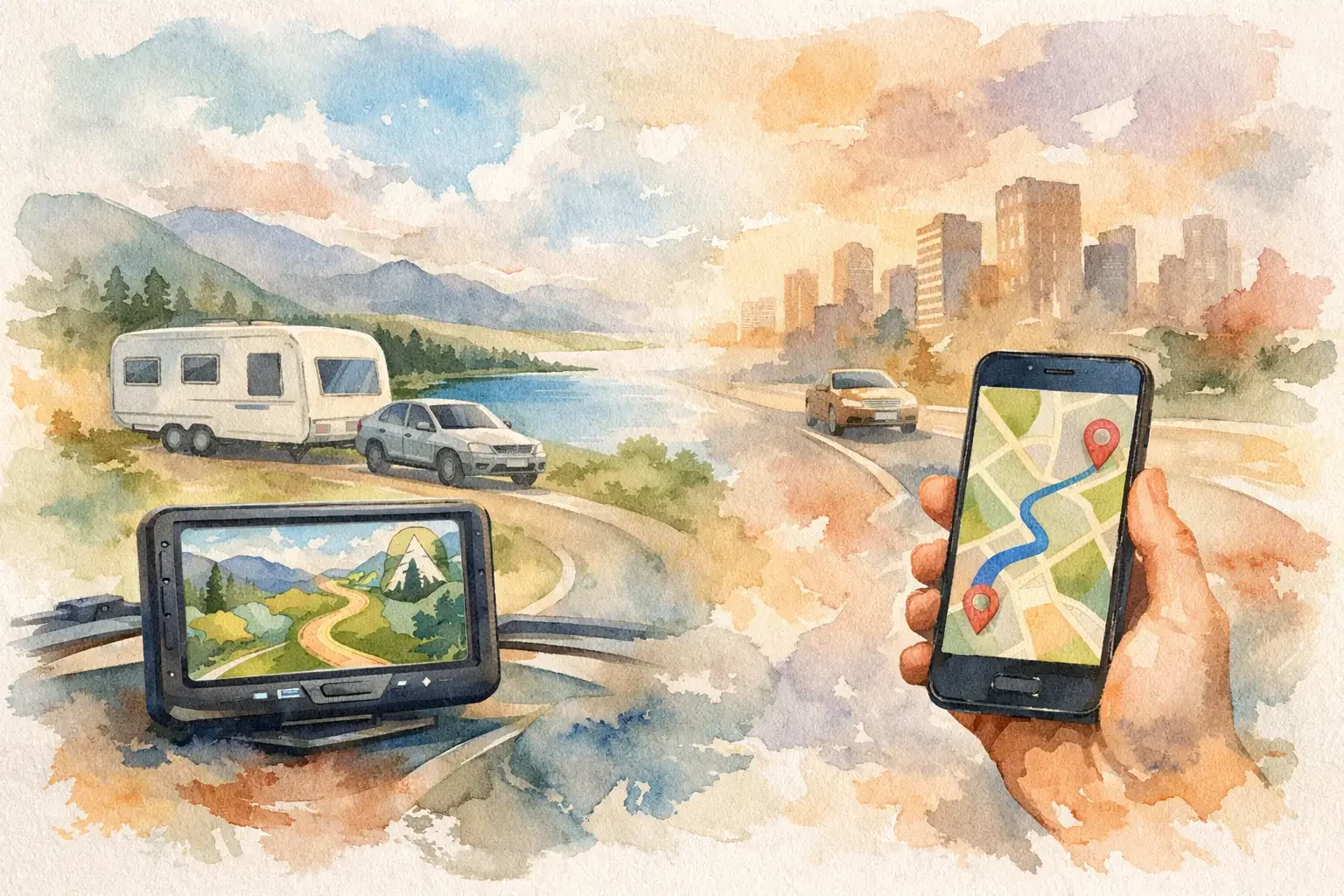
Caravan Sat Nav vs Google Maps
You only need to take one wrong turn into a narrow village lane, with a hedge on one side and a very patient queue forming behind you, to start wondering whether your phone is really the right tool for towing. That is why the question of caravan sat nav vs Google Maps keeps coming up. Not because one is magic and the other is useless, but because towing changes what a “good route” actually means.
For a solo car journey, the fastest route is often fine. For a car and caravan outfit, the best route is usually the one with fewer awkward junctions, fewer low bridges, fewer width restrictions and less chance of meeting a farm gate at a right angle while your dignity quietly leaves the vehicle. Speed matters less. Predictability matters more.
Caravan sat nav vs Google Maps - the real difference
The key difference is not screen size, branding or how cheerful the voice sounds when it sends you the wrong way. It is route logic.
A caravan sat nav is designed around vehicle dimensions and towing needs. In most cases, you can enter your outfit's height, width, length and sometimes weight. The device then tries to avoid roads that are unsuitable for that setup, such as low bridges, narrow lanes or roads with relevant restrictions.
Google Maps does not do that in the same way for UK caravanners. It is excellent at general navigation, traffic updates and finding places quickly, but it is largely built for ordinary car journeys. It may send you down a perfectly legal road that is technically passable, yet deeply annoying with a caravan on the back. And “technically passable” is not always the standard you want on a relaxing tour.
That does not automatically make a caravan sat nav better in every situation. It just means it solves a different problem.
Where a caravan sat nav earns its keep
If you regularly tow in unfamiliar parts of the UK, a caravan sat nav can reduce stress before it reduces mileage. That matters more than gadget marketing likes to admit. A calmer driver tends to make better decisions.
The big benefit is route filtering. If your outfit is tall enough to care about bridge heights, long enough to hate tight turns, or wide enough that single-track surprises stop being charming after about twelve seconds, a dedicated caravan unit can help keep you on roads that feel more realistic.
This is especially useful for the final part of the journey. Motorways and major A roads are usually the easy bit. The last ten miles are where things become more interesting. Campsites are often in rural areas, and rural navigation can go from straightforward to silly quite quickly. A caravan sat nav is often better at avoiding roads that look harmless on a phone screen but are less appealing when viewed through a windscreen with mirrors full of caravan.
There is also value in planning confidence. If you know the route has been built with your outfit in mind, you are less likely to second-guess every turning. That mental load is real, especially for newer caravanners.
Where Google Maps is genuinely brilliant
Google Maps is still very good at what it does. In some ways, better.
Live traffic is often the biggest advantage. If there is a closure, a jam or a delay ahead, Google Maps is quick to react and usually clear about alternatives. For ordinary roads and real-time conditions, it can be excellent. Search is also far better. If you need to find a fuel station, a supermarket, a services stop or the actual entrance to somewhere awkwardly pinned online, Google Maps is often easier and faster to use.
It is also familiar. That sounds trivial, but it is not. When you already know how to use a tool well, you are less likely to fumble with it under pressure. Plenty of caravanners tow safely using Google Maps, especially when they pair it with route checks beforehand and a bit of common sense on the day.
So this is not a case of old-school specialist kit defeating modern app wizardry. It is more a case of using the right tool for the right job.
The trade-off most people miss
The real caravan sat nav vs Google Maps debate is often framed as safety versus convenience. That is a bit too neat.
A caravan sat nav may produce a more suitable route, but it is only as good as its mapping data and setup. If you enter the wrong height or forget to update the maps, you can still get poor guidance. Likewise, some dedicated units can be slower, clunkier and less intuitive than the phone you use every day.
Google Maps, on the other hand, is convenient and current on traffic, but it does not truly understand your outfit. That means you may need to do more thinking yourself, particularly on approach roads near your destination.
Neither option replaces judgement. If a route looks ridiculous, treat it with suspicion, regardless of which screen suggested it. Sat navs are helpful, not clairvoyant.
What suits different types of caravanner?
If you are new to towing, a caravan sat nav often makes sense sooner rather than later. Not because beginners are incapable of using Google Maps, but because reducing avoidable stress helps you build confidence. Early towing trips are busy enough already. You are thinking about mirrors, lane discipline, stopping distances, speed limits, site arrival times and whether you've remembered the corner steady winder. One less thing to worry about is useful.
If you are experienced, tow a manageable-size caravan and know your usual routes well, Google Maps may be perfectly adequate for many trips. Especially if you already plan your route, check the final approach and avoid blindly following whatever the app throws at you.
If you tour widely across the UK, visit rural sites often, or tow a larger twin axle, a caravan sat nav becomes more attractive. The bigger the outfit and the less familiar the roads, the more valuable route filtering tends to be.
If budget is tight, start with planning habits rather than hardware. A dedicated unit is helpful, but it is not the only route to towing calmly.
A sensible middle ground
For many people, the best answer is not caravan sat nav or Google Maps. It is both.
Use a caravan sat nav for the main towing route, particularly where dimensions and restrictions matter. Then use Google Maps for live traffic awareness, searching stops, checking arrival details and confirming whether the site entrance is actually where the internet claims it is.
This approach gives you the specialist routing benefits without losing the convenience of a modern mapping app. It also gives you a second opinion, which is handy when one device appears convinced you should turn left into a lane designed by medieval sheep.
How to make Google Maps safer for towing
If you are sticking with Google Maps, either permanently or for now, the goal is to use it with a bit more discipline.
Plan the route before you leave, not from the driver's seat while the kettle cools on the kitchen side. Check the final section carefully, especially in rural areas. Look for obvious warning signs such as tiny lanes, sharp turns into villages, or routes that seem to cut through places you would not choose to drive a large van even without a caravan.
It also helps to compare the route with campsite directions. Many sites provide approach notes for a reason. They have watched enough outfits arrive to know which roads are sensible and which ones lead to regret.
And if something looks wrong on the road, do not press on out of loyalty to the blue line. Pull over safely and reassess.
So which should you choose?
If your question is which is more caravan-aware, the answer is the caravan sat nav. That is what it is built for.
If your question is which is more convenient day to day, it is Google Maps.
If your real question is which will make towing less stressful, it depends on how you travel. For occasional trips on familiar routes, Google Maps plus careful planning may be enough. For regular touring, larger outfits, or anyone who wants more confidence on unknown roads, a caravan sat nav is often money well spent.
There is no prize for doing it the hard way. Equally, there is no need to buy specialist kit just because someone online says it is the only proper method. Calm, sensible caravanning tends to work better than gadget one-upmanship.
If you want the practical answer, use the tool that helps you make fewer poor decisions and feel less wound up behind the wheel. That is usually the better investment, whether it lives on your windscreen or already in your pocket.
Need clearer caravan answers?
TalkWrench is where caravan questions get calm, experience-based explanations — without the noise, arguments, or guesswork.