
Caravan Speed Limits in the UK (No Guesswork)
You are happily rolling along, the outfit feels settled, the lane is clear, and then you clock it - a sign saying 70, a car whizzes past, and that little voice pipes up: "Hang on... what caravan speed limit UK rules actually apply to me?" If you have ever ended up towing at a speed that feels fine but slightly suspicious, you are in excellent company.
The good news is that UK caravan speed limits are simple enough once you separate three things that get muddled: the road’s limit, the limit for your type of vehicle, and the speed you should choose for the conditions. Only the first two are law. The third is judgement - and it is where confident towing actually lives.
What caravan speed limit UK law sets (the basics)
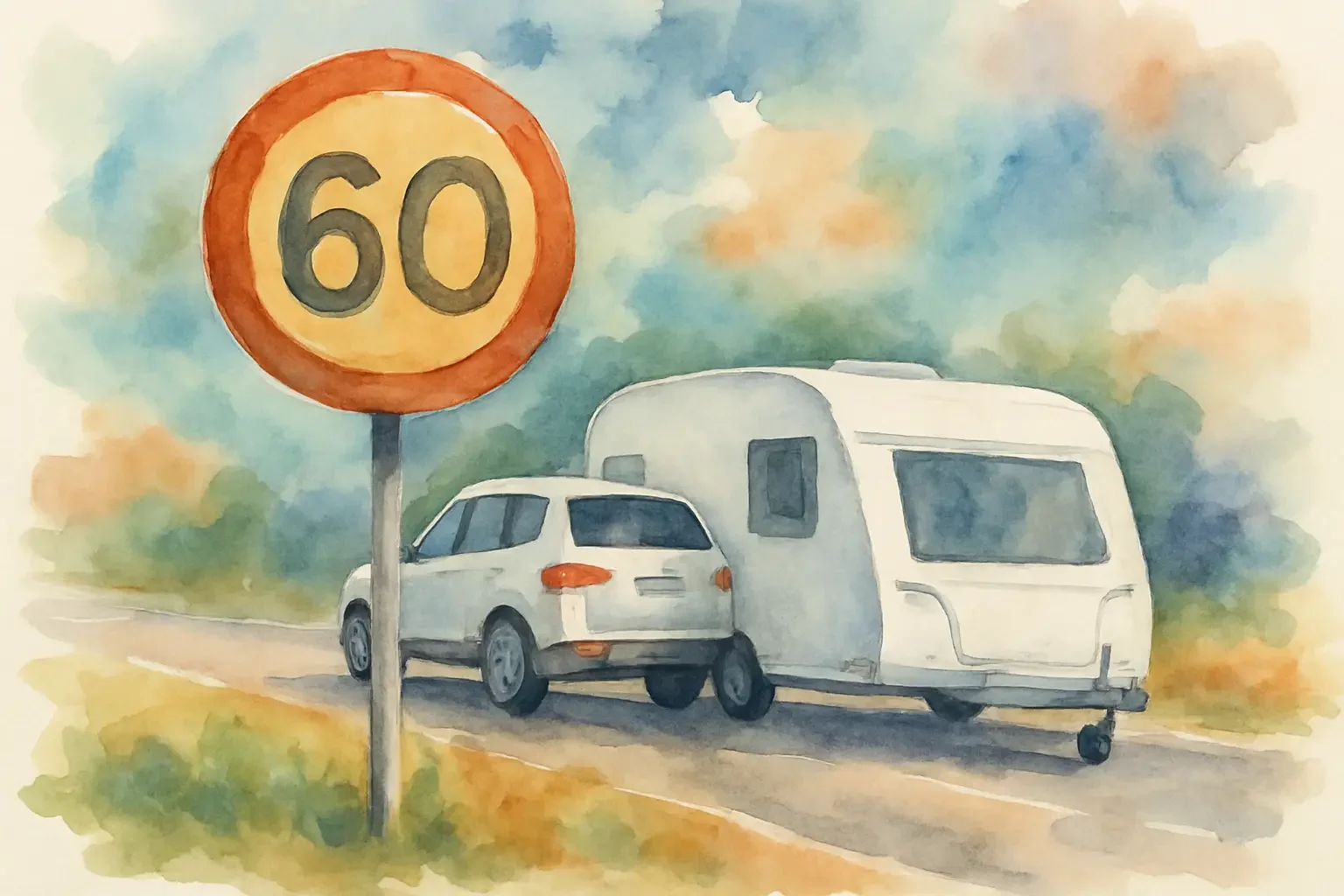
If you are towing a caravan with a car or a car-derived vehicle, the headline legal limits most people need are these: 60 mph on motorways and dual carriageways, and 50 mph on single carriageway roads.
That often surprises people new to towing because the signs still say 70 on a motorway and 60 on a single carriageway. Those signs are the national speed limit for cars not towing. When you have a caravan on the back, your legal ceiling is lower, even if the road is wide, dry, empty, and your caravan has promised to behave itself.
There is also a separate rule that catches people out: you must not use the right-hand lane of a motorway with three or more lanes in your direction of travel (unless directed to do so, or if lanes are closed). That is not a speed limit, but it matters because sitting at an indicated 60 while constantly being “encouraged” by faster traffic can tempt you into unnecessary lane changes. Plan to live in the left or middle lane and life gets calmer.
When those limits change (and why it depends)
The limits above apply to most car-and-caravan combinations, but not every towing setup is treated the same.
If you are towing with a goods vehicle over 3.5 tonnes maximum laden weight, different limits apply - and yes, that includes some larger vans or pickups used for work. Also, if you are towing a trailer that is not a caravan (like a box trailer or car trailer), the towing limits are broadly similar, but the vehicle category still matters.
Where people trip up is assuming the caravan changes the limit, full stop. Legally, it is the towing vehicle category and the fact you are towing that matter. If you are in any doubt about what your tow vehicle counts as, check the V5C vehicle logbook and the manufacturer’s plate. It is boring admin, but it beats learning your vehicle class from a roadside chat.
Speed limit signs vs towing limits: which one wins?
A practical way to think about it: you must obey whichever is lower.
If you are on a motorway with a temporary 50 mph restriction, that 50 applies to you. If you are on a clear motorway with the national limit for cars (70), your towing limit of 60 applies to you. If you are on a single carriageway posted at 40, then 40 is your legal cap even though your towing limit would otherwise be 50.
This also clears up the “but I was only doing the speed limit” defence. If the sign says 70 and you are towing at 70, you are not doing the speed limit for your vehicle - you are exceeding it.
The part nobody tells you: your speedo probably lies (a bit)
Most car speedometers over-read. That means when your speedo shows 60, your true speed might be 56-58. That is not a permission slip to aim for a higher number on the dial. It is just a reason to avoid obsessing over being perfectly exact and instead focus on being consistently legal and stable.
If you want reassurance, use a GPS speed reading as a sense check on a straight, steady stretch. Do not start “tuning” your cruising speed to squeeze out an extra couple of mph. You will gain very little time and burn a lot of attention you could be spending on anticipation and lane discipline.
Why the legal towing limits are lower
This is the bit that reduces anxiety. The lower limits are not there because every caravan is a snake waiting to happen. They are there because towing changes the physics and the margins.
Stopping distances increase. Even with excellent caravan brakes, you have more mass and more inertia to manage. Lane changes take longer. Crosswinds and bow waves from lorries have more influence. And if anything does start to go wrong - sway, a sudden avoidance manoeuvre, a tyre issue - the speed you are doing has a huge effect on whether it is a moment you manage or a moment that manages you.
In other words: the law builds in a buffer for imperfect roads, imperfect conditions, and imperfect humans. Which is all of us, at least before the second cup of tea.
Picking a comfortable touring speed (not a macho one)
Legal limits are ceilings, not targets. In real life, many experienced caravanners settle into a touring speed that gives them time to read the road and keep the outfit relaxed. That might be an indicated 55-60 on motorways and dual carriageways, and often less on single carriageways depending on bends, cambers, and traffic.
The trade-off is simple. Higher speed can feel tidy on a calm day but becomes tiring sooner, especially in wind or busy traffic. Slightly lower speed tends to reduce steering corrections, reduce “push” when being overtaken, and make your braking feel more spacious. It also often improves fuel consumption, which is not glamorous, but it does pay for chips.
If you are new to towing, give yourself permission to start a little slower. You are not “holding people up” if you are driving legally and predictably. You are a moving vehicle on a public road, not an obstacle placed there to ruin someone else’s schedule.
Single carriageways: where judgement matters most
Single carriageways are where the 50 mph towing limit exists for good reason. These roads can have hidden dips, tighter bends than they look, agricultural mud, and oncoming traffic with its own ideas about the centre line.
Here, a comfortable speed is the one that lets you keep your side of the road without feeling like the caravan is nudging you through corners. If you ever find yourself entering bends with a little clench and a little hope, you are already going too fast for that particular stretch, regardless of what the number says.
Also, do not be pressured into “making progress” for the sake of the car behind. Use lay-bys or safe straight sections to let a queue clear if it builds and it is sensible to do so. Not because you have to, but because it makes your drive quieter.
Motorways and dual carriageways: the calm lane game
Towing on motorways is often the easiest towing there is - as long as you treat it like a steady rhythm rather than a race.
Keep your following distance generous. Lorries will overtake you at a slightly higher speed and then pull back in. If you sit too close, you get the full buffet of turbulence and braking surprises. A little extra space turns those moments into non-events.
Be selective about overtakes. If you are only gaining 2 mph on the vehicle ahead, the overtake will take ages, annoy everyone, and tempt you into creeping above your limit. Sometimes the best overtake is none at all.
And remember the right-hand lane rule. On a four-lane motorway, that outside lane is not for you while towing. Staying out of it is not only lawful, it is soothing.
Common myths that cause unnecessary worry
One myth is that you must tow at 50 everywhere. You do not. You may tow up to 60 on motorways and dual carriageways (unless a lower limit applies), and up to 50 on single carriageways.
Another myth is that a lighter caravan automatically means you can tow faster. The speed limit does not scale with your caravan’s MTPLM or your car’s power. A well-matched, stable outfit is great - it just means you will be more comfortable within the same legal limits.
A third myth is that “everyone tows at 70”. Some do. That does not make it legal, and it does not make it clever. It usually just means they have not been caught, and their caravan has not yet decided to teach them a lesson.
A quick note on enforcement and consequences
Speed enforcement for towing is the same basic system as for any vehicle: if you are over the limit for your vehicle, you are over. Cameras may not always distinguish towing speeds perfectly in the moment, but relying on that is not a strategy. It is a hope-and-pray plan.
If you are involved in an incident, towing over the legal limit can complicate everything - not just from a legal standpoint, but in how your driving is judged afterwards. The calmest approach is to make your compliance boring.
If you want the calm version of “check your setup”
Speed is only one part of towing confidence. Loading, noseweight, tyre pressures, and simple habits like gentle steering inputs all influence stability and how safe your chosen speed feels. If you want more experience-led guidance without the forum arm-waving, CaravanVlogger has a solid set of towing and weights resources at https://caravanvlogger.co.uk.
FAQs people ask when they are still not quite sure
Can I tow a caravan at 70 mph in the UK?
Not legally with a car and caravan. The limit is 60 mph on motorways and dual carriageways, unless a lower limit applies.
Is the caravan speed limit UK-wide the same in England, Scotland and Wales?
The towing limits discussed here apply across Great Britain. Always follow any local temporary restrictions and road signage.
Does the speed limit change if I have a stabiliser or ATC?
No. Stability aids can help manage certain situations, but they do not change the legal limit. Think of them as extra margin, not extra permission.
The most relaxing towing days are rarely the fastest ones. Set a pace that keeps the outfit settled, leaves you mental space to think ahead, and gets you to site feeling like you could happily do it again tomorrow.
Check Out The Other Guides
These three guides are designed to work together, not compete:
Towing Without the Panic → confidence on the road
Setup & Site Life – Without the Stress → calm arrival, living, and departure
Caravan Ownership – What Actually Matters → long-term clarity and confidence
Need clearer caravan answers?
TalkWrench is where caravan questions get calm, experience-based explanations — without the noise, arguments, or guesswork.