
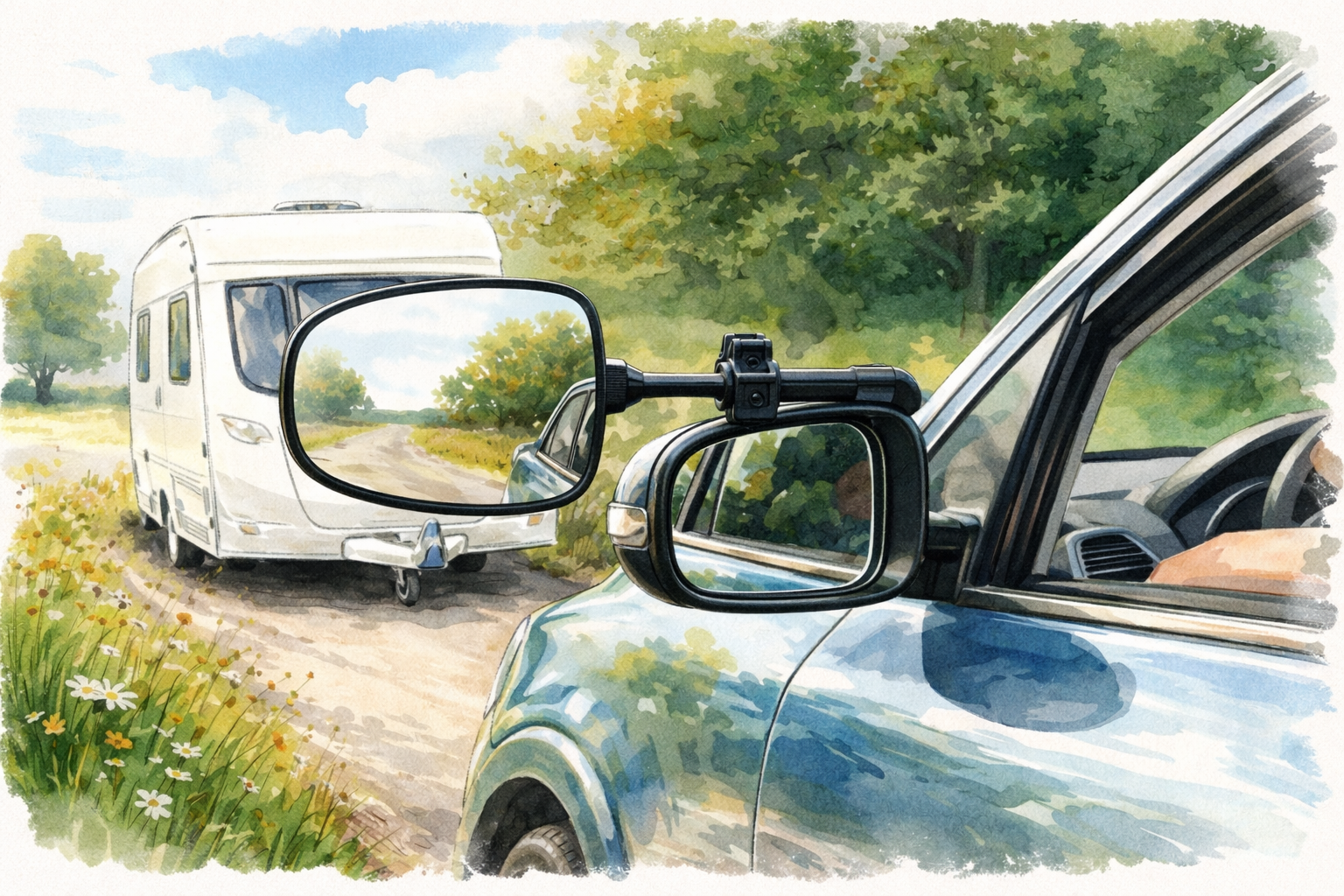
Caravan Towing Mirrors UK: What Matters
Towing mirrors are one of those bits of kit people either overthink for a week or buy in a panic on the morning of a trip. Usually from a petrol station. Usually badly. The good news is that this is simpler than the internet makes it sound.
If your caravan is wider than your car and it blocks your rearward view, you need extension mirrors. Not because it looks keen and professional, but because you need a proper view down both sides of the caravan when towing. That is the bit that matters.
Caravan Towing Mirrors UK - what the law actually expects
The legal principle in the UK is straightforward. You must have an adequate view to the rear. If your caravan prevents that through your standard car mirrors, extra mirrors are required.
A commonly quoted rule is that you should be able to see 4 metres out from the side of the caravan and 20 metres behind it. That is the practical standard people work to, and for good reason. It gives you a usable field of vision for lane changes, filtering traffic and keeping tabs on what is happening alongside the van.
So, for most caravanners, the answer is not really a philosophical one. If your caravan sits wider than the car, fit towing mirrors. Most do. If you are unsure, err on the sensible side rather than trying to win a technical argument in a lay-by.
This also sits alongside the wider legal side of towing. If you are still piecing together the basics, read Can I Tow a Caravan Legally in the UK? as well, because mirror compliance is only one part of the picture.
What you actually need from a towing mirror
You do not need the most expensive mirror on the market. You need one that stays put, gives a stable image and fits your car properly.
That last point matters more than many buyers realise. A brilliant towing mirror with a poor fit on your particular car is not brilliant at all. It is just an irritating little wobble machine that gradually points at the hedge.
In practice, a good towing mirror should clamp securely without damaging the car mirror housing, avoid excessive vibration at speed, and be simple enough to fit without requiring the patience of a watchmaker. If it takes half an hour, three tools and a mild loss of faith every time you set off, it is the wrong mirror for you.
Flat glass is generally the better choice for a true, less distorted view. Convex glass can widen the field of vision, but objects may appear further away than they really are. Some people like that extra angle, others hate it. This is one of those areas where personal preference is allowed. Caravanning does not need more dogma.
The best towing mirror types for UK caravanners
There are three broad camps. Strap-on universal mirrors are usually the cheapest, and sometimes the most fiddly. They can work perfectly well, but quality varies wildly. Good ones are decent value. Bad ones flap about like a startled pigeon.
Clamp-on mirrors tend to be the most popular because they offer a firmer fit and usually less vibration. For many people, this is the sweet spot between price and usability.
Vehicle-specific mirrors are designed for particular car models and often give the neatest, most secure fit. If you tow regularly and keep the same tow car for a while, these can be worth the extra money. If you change cars often, universal mirrors may make more sense.
Well-known names that UK caravanners often consider include Milenco, EMUK and Maypole. Milenco is especially common because the range is broad and parts are easy to find. EMUK mirrors are often praised for fit and stability, but they are usually pricier. Maypole sits more towards the budget end and can be absolutely fine if the fit works on your car.
The bit that catches people out - fitting
A legal towing mirror that is fitted badly is still a problem. Before setting off, sit in the driving position and adjust each mirror so you can see clearly down the full side of the caravan and into the lane beyond. Then check again after a few miles. New mirrors sometimes settle slightly once you are moving.
If the mirrors vibrate badly, loosen or slip, do not just carry on hoping for the best. Refit them properly or change model. A poor rearward view is tiring, and tired drivers make poor decisions.
This is also where beginners often buy too much rubbish while trying to solve a simple problem. One decent pair of mirrors that suits your car is better than a drawer full of clever-looking accessories. If that sounds familiar, Why new caravanners buy far too much kit may feel uncomfortably accurate.
Which option is best for most people?
If you are new to towing, a good-quality clamp-on mirror from a reputable brand is usually the safest recommendation. It keeps things simple, fits a wide range of cars and avoids the worst of the wobble that plagues bargain-bin options.
If you tow often and already know your tow car is staying put for a few years, vehicle-specific mirrors can be a very good upgrade. They cost more, but they tend to be easier to trust on longer journeys, especially in poor weather or on motorways.
And if you are only towing occasionally, a decent universal set is often all you need. Not glamorous, not dramatic, just functional. Which, to be fair, describes quite a lot of caravanning equipment.
Before your first proper trip, it is worth building mirror checks into your departure routine, along with hitching, lights and noseweight. Our First Caravan Trip Checklist That Actually Helps covers the sort of practical checks that reduce stress before you leave.
The short version is this: if the caravan restricts your view, fit towing mirrors. Choose a pair that fits your car securely, gives a stable image and does not turn every journey into a small engineering dispute. You are not shopping for the perfect mirror for all humanity - just the one that lets you tow calmly and see what you need to see.
Need clearer caravan answers?
TalkWrench is where caravan questions get calm, experience-based explanations — without the noise, arguments, or guesswork.