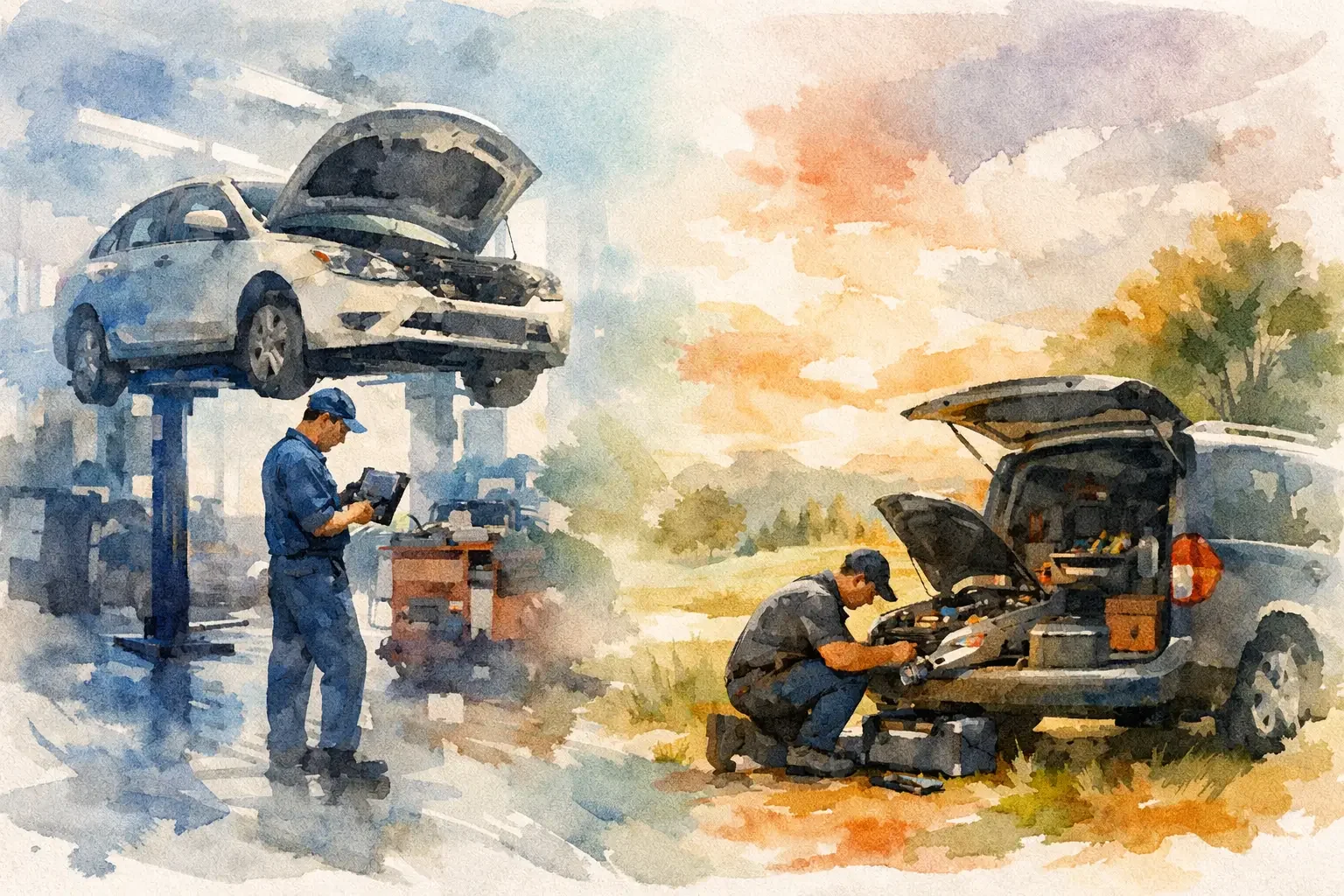
Dealer Service vs Mobile Engineer
If your caravan service is due and you are already picturing phone calls, towing slots, and someone saying "it depends", I have both good and mildly irritating news - it does depend. The dealer service vs mobile engineer question is not really about which option is universally better. It is about which one makes the most sense for your caravan, your warranty, your storage setup, and your tolerance for faff.
A lot of owners assume the dealer is the "proper" route and a mobile engineer is the fallback. That is not always true. Equally, mobile servicing is not automatically the cleverer, easier, more enlightened choice either. This is caravanning, after all. There is usually a practical answer, but rarely a dramatic one.
Dealer service vs mobile engineer - what is the actual difference?
At the simplest level, dealer service means taking your caravan to a dealership or workshop for its scheduled servicing, repairs, or warranty work. A mobile engineer comes to the caravan instead, whether that is at home, in storage, or sometimes on site depending on the job.
Both can inspect, service, test, and repair caravans. Both may be highly competent. Both may also vary a bit in how booked up they are, how clearly they communicate, and whether they leave you feeling reassured or vaguely in need of a lie down.
The difference is less about the basic idea of servicing and more about access, convenience, facilities, manufacturer requirements, and the kind of work being done.
When dealer servicing makes more sense
A dealer can be the right choice when your caravan is still under manufacturer warranty and the work is likely to involve warranty claims, parts ordering, or liaison with the manufacturer. If a fault needs authorisation, photos, specific documentation, or parts that are tied to the supplying network, a dealer may have a more direct route.
There is also the matter of workshop equipment and capacity. Some jobs are simply easier in a fixed workshop. If the caravan needs more extensive repair work, bodywork attention, damp investigation beyond routine checks, or multiple faults sorted at once, a dealer setup may be more practical. They have space, lifts or jacks suited to workshop use, stocked parts, and access to systems that a lone engineer working from a van may not.
Another point is record-keeping. Some owners like having all service and repair history tied to the supplying dealer or a recognised workshop. That can feel tidier, especially if the caravan is relatively new or likely to be sold in the near future.
That said, tidier does not always mean better. Dealers can be booked weeks or months ahead, especially in spring when everyone suddenly remembers service intervals at exactly the same time. You may also need to tow the caravan there and leave it for days, which is less appealing if your storage site is one direction, the dealer is another, and your free time is not infinite.
When a mobile engineer is the better fit
Mobile engineers come into their own when convenience matters and the work is routine or clearly defined. If your annual service is due, the caravan is at home or at a storage site that allows access, and there is no obvious major fault requiring workshop-based repair, mobile servicing can be the easiest route by miles.
You avoid towing just for the sake of a service. That matters more than some people admit. Towing to a dealer is not difficult for everyone, but for newer owners, anyone rebuilding confidence, or those with limited time, cutting out an unnecessary trip can make caravan ownership feel much less burdensome.
A good mobile engineer can also be more personal. You are often dealing directly with the person doing the work rather than a service desk, workshop controller, and a mystery gap in the middle. That can mean clearer explanations, practical advice, and less chance of your concerns being translated into dealer-speak and then back again.
For many owners, especially those with caravans out of warranty, this is where the balance shifts quite strongly. If the service book requirements are met and the engineer has the right approval or accreditation for your caravan and warranty situation, mobile servicing is not some second-tier option. It is often just the sensible one.
The warranty question matters more than the debate
This is where people get tied in knots. Not because it is wildly complicated, but because there is so much half-advice floating about.
If your caravan is under manufacturer warranty, check what the warranty and service schedule actually require. Do not rely on what a bloke on a forum said in 2019 with full confidence and no evidence. Some manufacturers require servicing to be completed by an approved workshop or engineer within specific time windows. Miss the timing, use someone who does not meet the conditions, or fail to get the paperwork completed properly, and you may give the manufacturer room to reject a later claim.
That does not automatically mean dealer only. In many cases, an approved mobile engineer is perfectly acceptable. The key point is not whether they travel by van or work behind a roller shutter. It is whether they meet the manufacturer's servicing requirements and can stamp and document the service correctly.
If you are unsure, ask the manufacturer or check the warranty terms in writing. It is not glamorous, but neither is arguing over damp repairs because someone guessed.
Cost is not just the headline price
People often compare dealer and mobile prices as if the invoice tells the whole story. It does not.
A dealer may charge a competitive rate for the service itself, but you need to factor in travel, fuel, time off, and the practical cost of dropping off and collecting the caravan. If the caravan is in storage, that can turn a service into a half-day operation before anyone has even looked at the brakes.
A mobile engineer may charge a call-out or mileage fee depending on location, but the overall cost can still work out better once you account for the towing and time saved. There is also the smaller, less measurable benefit of not having to shuffle your week around a workshop slot.
Of course, if a mobile engineer identifies work that needs a dealer or specialist repairer afterwards, you may end up paying twice in inconvenience if not in labour. That is one of the trade-offs. Cheap is not always cheap if it creates a second job.
Quality depends more on the person than the format
This is probably the least exciting answer, but it is the honest one. A careful, experienced mobile engineer is better than a poor dealer workshop. A strong dealer technician is better than a rushed mobile service. The badge on the van or the building does not guarantee much on its own.
What matters is competence, communication, and whether the person doing the work is thorough. Do they explain advisories clearly? Do they note damp readings properly? Do they test systems rather than glance at them hopefully? Do they understand caravan construction, appliances, running gear, and the common issues for your type of van?
Recommendations help, but look for specific recommendations, not vague praise. "Brilliant service" is pleasant but not useful. "Found a cracked brake shoe, explained the damp readings properly, and sorted the paperwork without fuss" tells you far more.
Storage, access and logistics can decide it for you
A surprisingly large part of dealer service vs mobile engineer comes down to where the caravan lives.
If your storage site permits mobile servicing and gives proper access, that can make life very easy. If it does not, the mobile option may vanish immediately. Likewise, if your caravan is kept at home on a driveway with enough space to work safely, a mobile engineer is straightforward. If it is squeezed behind gates, nose-down on a slope, with no access to one side, less so.
Dealers have the advantage of a controlled environment. Mobile engineers need workable conditions. Neither of these is a moral issue. It is just practical reality.
So which should you choose?
If your caravan is under warranty, start with the warranty terms and work backwards from there. If a dealer is required, that settles it. If an approved mobile engineer is allowed, then convenience, trust, and the likely type of work should guide your choice.
If your caravan is out of warranty and you mainly need routine servicing, a good mobile engineer is often the easiest and most owner-friendly option. If the caravan has complex faults, needs specialist repair, or you want one place to manage a larger job, a dealer or workshop may be the better call.
For plenty of owners, the best answer is not loyalty to one side. It is using both when each makes sense. Routine servicing with a trusted mobile engineer, workshop repair when a bigger issue turns up, and no need to turn it into a tribal debate over tea in the awning.
The right choice is the one that keeps your caravan safe, properly maintained, and realistically usable without adding drama where none is needed. Caravanning has enough moving parts already. Your servicing decision should make ownership calmer, not more complicated.