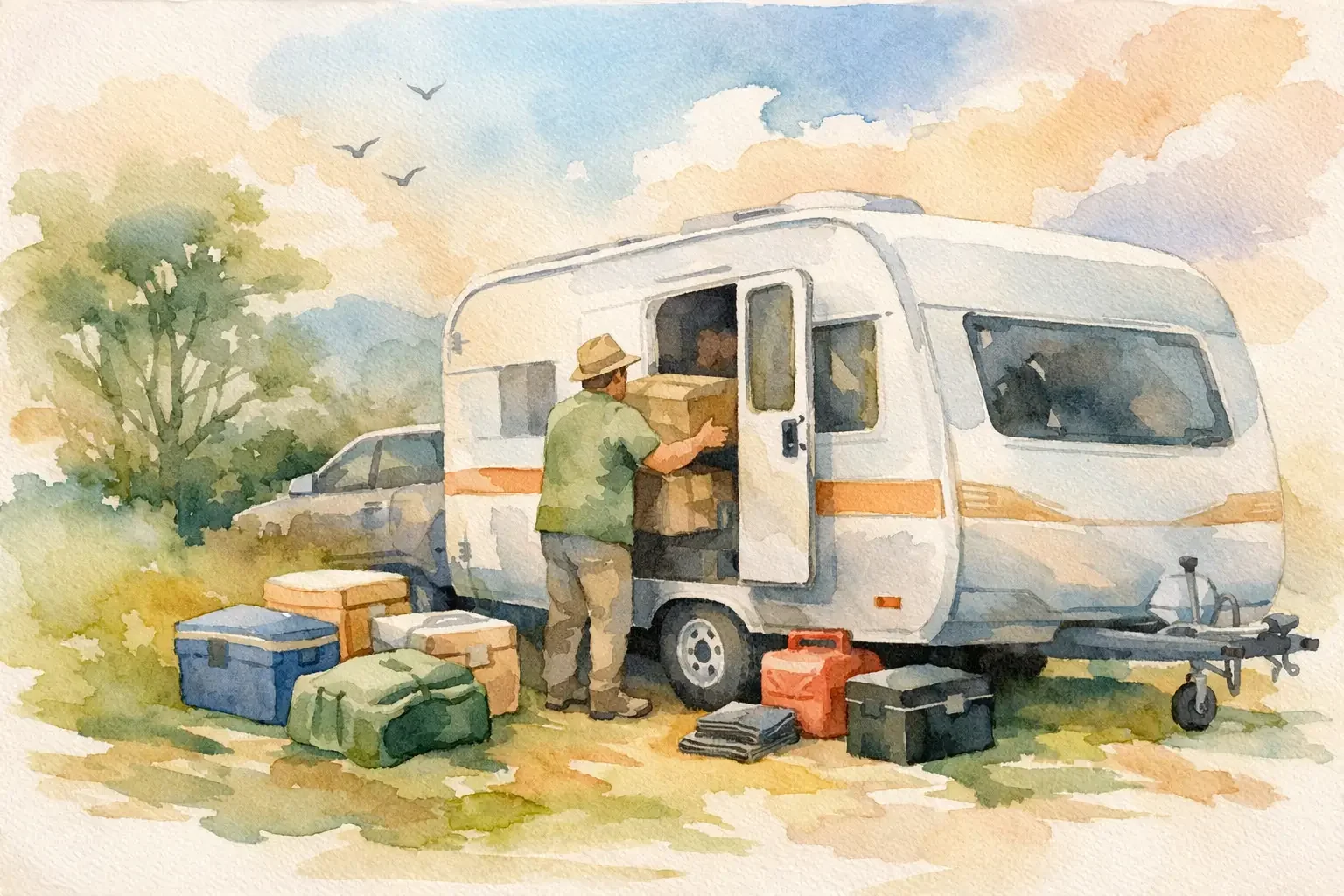
If your caravan feels twitchy at 55 mph, there is a fair chance the problem started on the driveway, not on the road. Learning how to load a caravan properly is less about military-grade packing discipline and more about balance, weight awareness, and not chucking the awning wherever it happens to fit five minutes before departure.
A lot of the anxiety around loading comes from half-true rules repeated so often they begin to sound like law. Put everything over the axle. Never put anything in the rear washroom. Always travel with this empty and that full. Some of that advice points in the right direction, but very little of it works as a universal rule. The sensible approach is to understand what loading is trying to achieve, then make practical decisions based on your caravan, your tow car, and what you are actually taking.
What proper caravan loading is really about
When people ask how to load a caravan properly, what they usually mean is how to make it tow safely and predictably. That comes down to three things: staying within your legal weight limits, achieving a sensible noseweight, and keeping the load stable so the caravan is not encouraged to wobble about when you meet crosswinds, poor road surfaces, or an enthusiastic artic.
You are not aiming for some mythical perfect loading pattern. You are aiming for a caravan that sits within its limits and behaves calmly behind the car. If you can do that consistently, you are doing well.
The first part is the boring but essential bit - knowing your numbers. Your caravan has a maximum technically permissible laden mass, often still referred to in everyday use as MTPLM. Your actual payload is the difference between that figure and the caravan’s mass in running order. If your payload is tight, loading well matters even more because there is less room for guesswork and fewer chances to bring along things you do not need.
Start with weight limits before you pack anything
Before deciding where things should go, make sure they should go at all. It is remarkably easy to carry far more than you think, especially once you add mover batteries, aquarolls, petrol bottles, awning kit, levelling blocks, chairs, food, clothes, and the miscellaneous collection of useful items every caravanner accumulates over time.
This is where beginners often get caught out. The caravan looks half empty, so it feels as though it must be fine. Unfortunately, empty space does not weigh anything, but the motor mover, full wardrobe and box of tools very much do.
A proper loading routine starts with honesty. Weigh or at least estimate individual items sensibly. The heavy items deserve your attention first because they have the biggest effect on both total weight and balance. If you are close to the caravan’s payload limit, it often makes more sense to move some items into the car rather than playing luggage Tetris inside the van and hoping for the best.
How to load a caravan properly for balance
The simplest rule is still the most useful: keep heavier items low down and as close to the axle line as practical. That reduces the leverage those items have on the caravan and helps keep the outfit more stable. A toolbox on the floor near the axle is generally a better idea than a toolbox in an overhead locker or tucked right at the back.
That does not mean every heavy item must be placed exactly over the axle with a spirit level and a small prayer. Real caravans have fixed furniture, awkward lockers and the irritating habit of not being designed around your folding barbecue. Close to the axle is good. Low down is good. Secure is non-negotiable.
What you want to avoid is collecting too much weight at either extreme end. Load too much at the rear and you may reduce noseweight and make the caravan more prone to instability. Load too much at the front and you can push noseweight beyond the car or towbar limit. Neither is clever, and both are more common than people think.
Noseweight matters, but so does context
Noseweight is one of those subjects that can become weirdly dramatic. In reality, it is just the downward force the caravan puts onto the towball. It matters because it affects how the caravan follows the car. Too little noseweight can contribute to instability. Too much can exceed the limits of your tow car, towbar or caravan hitch.
The sensible target is usually to load up to the highest noseweight allowed by the lowest-rated component in the system, without exceeding it. That may be the car, the towbar, or the hitch assembly. The lowest figure wins.
This is where context matters. If your heavy kit is all naturally stored ahead of the axle, your noseweight may rise quickly. If you tend to fill the rear washroom with chairs, cables and the sort of "just in case" gear that follows caravanners around like a loyal dog, your noseweight may end up too low.
Checking noseweight before you travel is not overkill. It is simply part of getting the outfit ready. It gives you a chance to move a few items before they become a motorway lesson in regret.
What should go in the car instead?
One of the easiest ways to improve caravan loading is to stop insisting the caravan must carry everything. The tow car is often the better place for dense, heavy items, provided you do not overload the car and you load it sensibly too.
Items such as awning poles, bottled drinks, heavy food crates, tool bags and similar dense gear can often be carried more effectively in the car boot, ideally low down and secured. This can help reduce caravan payload pressure and make it easier to achieve a sensible noseweight.
There is a trade-off, of course. Load too much into the very back of the car and you can affect the car’s own axle loads and handling. So the answer is not "put all the heavy stuff in the car". It is "use both vehicles sensibly". As with most caravanning advice, the middle ground is doing most of the work.
Water, petrol and all the usual pre-trip debates
This is where forum certainty tends to outpace real life. Should you travel with water in the onboard tank? Should the toilet flush tank be empty? Should petrol bottles stay in?
Generally, travelling with unnecessary water on board just adds weight, and water can move around as you drive. So if you do not need to carry it, there is little point. Many caravanners travel with fresh water and waste containers empty for that reason. But some systems or travel plans may mean carrying a small amount makes sense. That is fine, as long as it is a conscious decision and accounted for in your weight.
Petrol bottles are different because they are often part of the caravan’s expected travelling setup. They should be carried securely in the proper locker. The key is not to improvise storage for heavy cylinders elsewhere, which should go without saying but somehow never quite does.
Secure the load, not just the weight
A caravan can be within every weight limit and still be badly loaded if the contents are free to move. A crate that slides across the floor or a locker full of loose tins can shift weight where you do not want it. It can also damage the caravan interior, which is an expensive way to learn a simple lesson.
Use the storage spaces as intended. Keep heavy items on the floor, pack them tightly enough that they cannot move around, and do not overload lockers or shelves that were never designed for serious weight. Overhead lockers are for lighter things. Bedding, coats and similar items are usually fine. Cast iron cookware and a bag of dog food, less so.
Before setting off, open a few lockers and ask yourself a blunt question: if I brake sharply, where is this lot going? If the answer is "probably through that cupboard door", repack it.
A practical loading routine that actually works
The easiest way to avoid loading chaos is to use the same routine every trip. Start with the heavy essentials and place them low down near the axle. Then add medium-weight items where they fit without concentrating too much mass at either end. Keep light, bulky things in higher lockers. Finally, check noseweight and make small adjustments if needed.
This routine also helps you notice what you do not need. If an item keeps being packed but never used, it is not really part of your touring kit. It is just enjoying the holiday more than you are.
Many owners also benefit from keeping a rough written loading plan, especially after a trip where the outfit towed particularly well. You do not need a spreadsheet worthy of an engineering firm, just a simple reminder of what goes where and what travels in the car. CaravanVlogger has long taken the view that confidence comes from repeatable habits, not from pretending every departure is a fresh puzzle.
Common loading mistakes that cause trouble
The classic mistakes are predictable. Too much weight at the back. Heavy items high up. Assuming the caravan can carry more than it can. Forgetting the mover and battery count towards payload. Filling every storage space because it exists. None of this is unusual, and none of it means you are bad at caravanning. It just means you are normal.
Another common mistake is chasing rigid rules instead of paying attention to outcomes. If someone says never store anything in the front locker or always keep every chair in the washroom, treat that advice with caution. Your caravan’s layout, your payload, your noseweight and your tow car all affect what makes sense. Broad principles matter more than slogans.
A well-loaded caravan should feel planted and predictable, not floaty or busy. If your outfit has felt unsettled on previous trips, loading is one of the first areas worth reviewing. Not because every towing issue is caused by packing, but because this is one of the few variables you can control quite easily.
Getting this right is not about impressing anyone at the storage yard. It is about giving yourself an easier, calmer tow and arriving with a caravan that feels ready for a holiday rather than a post-mortem.