
How to Reverse a Caravan Without the Drama
Most caravan reversing goes wrong before the outfit even starts moving. Not because anyone is hopeless, but because the angle is poor, the space is tighter than expected, or somebody is trying to direct matters with the sort of hand signals normally seen on a windswept aircraft carrier.
If you want to know how to reverse a caravan safely, the good news is that this is a skill, not a gift bestowed on a chosen few at birth. Some people make it sound mystical. It isn't. It is mostly about slow speed, good setup, clear communication and accepting that a tidy reset is far better than forcing a bad line and hoping for the best.
What makes caravan reversing feel so awkward?
A caravan pivots in the opposite direction to what your brain expects at first. Turn the steering wheel one way and the caravan begins to move the other. Add mirrors, pressure from waiting traffic, and the mild dread of clipping a post, and it is no wonder people tense up.
The other reason it feels difficult is that very small steering inputs make a big difference once the caravan starts to bend. Beginners often overcorrect, then chase the swing, then end up at an angle that would trouble even the most cheerful site warden.
That is why calm matters. Reversing well is not about being fast. It is about being deliberate.
Before you reverse, make the job easier
The safest reverse is the one you have simplified before moving. If you can choose your approach, do. A wider entry angle and more room on the driver’s side usually make life easier because you can see the caravan more clearly in the mirror.
Get out and look first. Check for low posts, bollards, tree stumps, levelling blocks, tap points and the sort of hidden obstacles that somehow sit exactly where your wheel wants to go. On a pitch, also look at the slope and the surface. Wet grass, gravel and mud can change how smoothly the outfit rolls back.
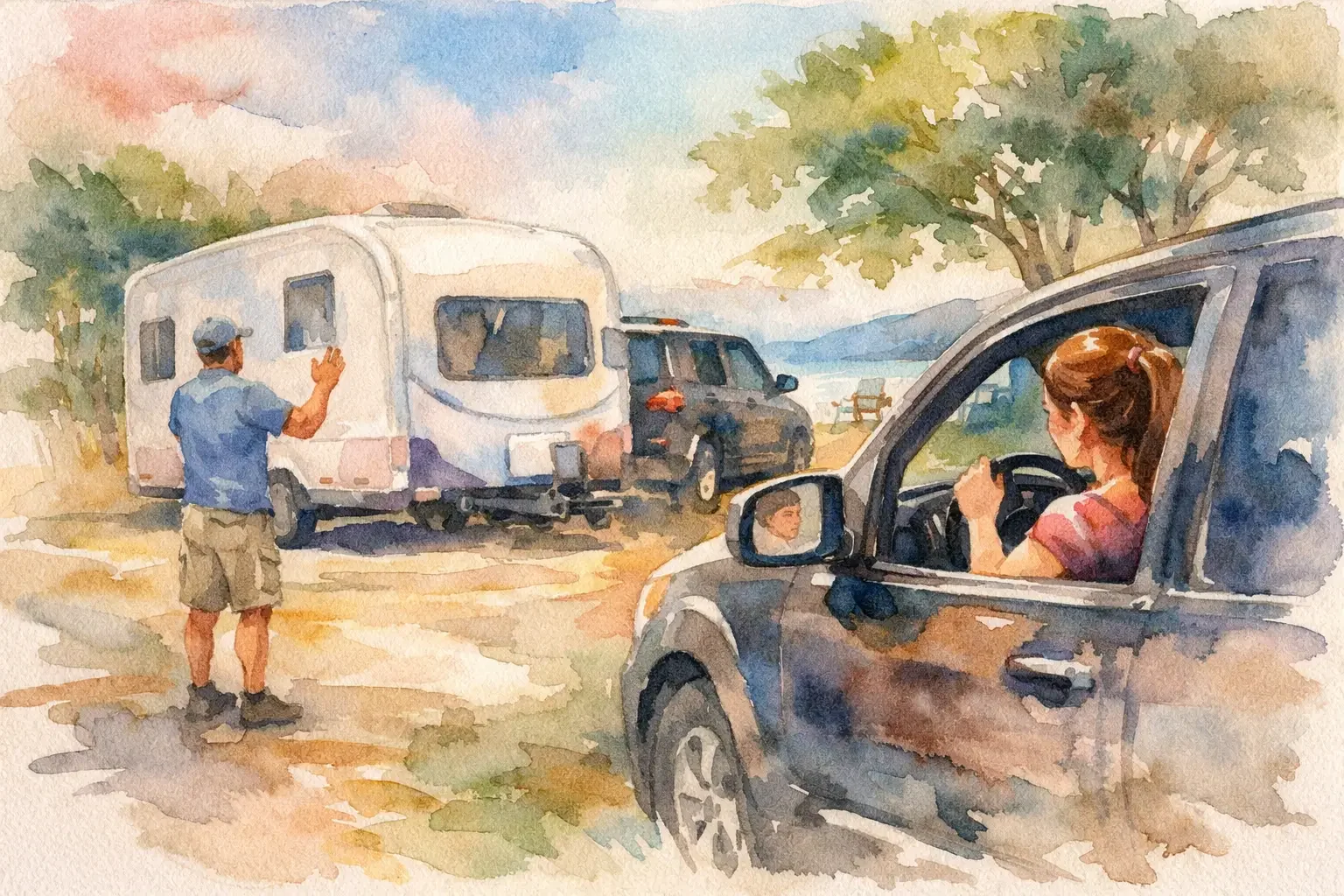
If you have a passenger acting as a spotter, agree the plan before you start. Keep it simple. Decide where the caravan needs to end up, which side needs the closest watch, and what signal means stop. If your helper likes giving twelve instructions in three seconds, gently reduce the role. One calm spotter is useful. A panicked choreographer is not.
Use a spotter properly
A spotter should stay where the driver can see them at all times and never stand between the tow car and caravan. If they disappear from view, stop immediately. No debate, no guesswork.
Voice communication helps if you have radios or phones on speaker, but visual stop signals still matter. Technology is handy until it crackles, drops out or decides this is the perfect moment to be unhelpful.
How to reverse a caravan safely in a controlled way
Start with the outfit as straight as possible. This gives you a clean beginning and delays the point at which the caravan starts turning sharply. Reverse very slowly - slower than you think. Idle speed with careful clutch control is usually plenty in a manual car, and gentle brake control matters just as much in an automatic.
Hold the steering wheel low, with one hand around the bottom if that helps you. Many people find this makes the direction more intuitive. Move your hand left, and the rear of the caravan tends to go left. Move it right, and the rear tends to go right. It is not the only method, but it works well for a lot of drivers because it reduces that left-is-right mental muddle.
Make small steering inputs and then wait. That pause is important. The caravan takes a moment to respond, and if you keep adding more lock before it has reacted, you will create the very bend you were trying to avoid.
Once the caravan starts to follow the line you want, gently unwind the steering to follow it. This is where many reverses unravel. People make the initial turn correctly, then leave too much lock on and the caravan tightens in too quickly.
Watch the mirrors, not just one side
Your mirrors are your main reference. Check both regularly. One mirror usually shows the turn developing more clearly, but the other tells you if the caravan is getting too close to something or beginning to jack-knife.
Do not stare at a single corner. Reversing safely is about the whole outfit. You need to know where the back of the caravan is going, how sharply it is bending, and whether the tow car still has room to straighten.
When to stop and pull forward
This is the bit confident caravanners learn sooner or later - pulling forward is not failure. It is judgement.
If the angle tightens too much, if you lose sight of your spotter, if the caravan starts heading somewhere unhelpful, stop. Pull forward a little to straighten the outfit and set up another attempt. That small reset is quicker than trying to rescue a poor line with frantic steering.
There is no award for doing it in one sweep. The only people who care are usually the ones not paying your repair bill.
Tight pitches, gateways and awkward site roads
Some situations are genuinely more awkward. Narrow site roads, hedges, parked cars and pitches with a sharp turn at the last moment can make reversing feel like a puzzle designed by somebody with a grudge.
In these cases, your approach matters even more. Use as much road width as you safely can before beginning the turn. A slightly different starting position can turn a horrible reverse into a manageable one.
If the pitch is on your offside, visibility may be worse. That does not mean it cannot be done, only that you may need more checks, a better spotter and perhaps an extra pull-forward correction. If conditions are busy or cramped, waiting a minute for space to clear is often the smartest move.
Slopes need extra respect
Reversing uphill may need a little more power, but not a rush. Reversing downhill can build momentum more quickly than people expect, especially on loose surfaces. Keep speed very low and stay ready to stop smoothly.
If you are under pressure from people waiting behind you, ignore it. Politely if possible, completely if necessary. A safe reverse done slowly is better than a fast one done to please strangers.
Common mistakes and what to do instead
The big one is steering too much, too soon. The fix is simple but not always easy - smaller inputs, then wait for the caravan to react.
Another common mistake is starting the reverse with the outfit already at an awkward angle. Straighten first if you can. A good setup saves a lot of correction later.
Then there is the classic helper problem. Mixed signals, waving arms, sudden urgency. If communication is poor, stop and reset the plan. Calm beats complicated every time.
And finally, people often keep going past the point where they should have paused. If it feels messy, stop earlier. You do not get extra marks for commitment.
Should you use a motor mover instead?
Sometimes, yes. A motor mover can make positioning on a pitch much easier, especially in tight spaces or if physical mobility is a factor. There is no shame in using one. It is a tool, not a moral issue.
That said, it helps to understand basic reversing even if you have a mover. Batteries fail, terrain varies, and not every situation suits remote-controlled perfection. Knowing how the caravan behaves when attached to the car still gives you options.
Practise where the stakes are low
If reversing makes you anxious, practise somewhere quiet before your next trip. An empty storage yard with permission, a spacious farm track, or another suitable private area is ideal. Use cones or markers and rehearse gentle turns, straight-line reversing and stopping to reset.
Short sessions are usually better than one marathon afternoon of frustration. The goal is to build familiarity, not prove toughness. After a while, your brain starts to recognise what a small input actually does, and the whole process becomes less theatrical.
If you want more practical towing help in the same calm spirit, CaravanVlogger has plenty of guidance at https://caravanvlogger.co.uk.
A simple mindset that helps
Treat reversing as a slow positioning exercise, not a performance. You are not there to impress the site, silence the children, or satisfy the chap who reversed his van perfectly in 1998 and has mentioned it ever since. You are there to place your caravan safely, with enough control to stop, correct and carry on.
That is usually what confidence looks like in caravanning. Not swagger, not speed, just enough calm to do the sensible thing before it becomes the expensive thing.
Where to Start
If you’re not sure where to begin, most people find this page the most helpful first step:
👉 Arriving on Site – The Calm Order of Things
It sets the tone for everything that follows.
Need clearer caravan answers?
TalkWrench is where caravan questions get calm, experience-based explanations — without the noise, arguments, or guesswork.