
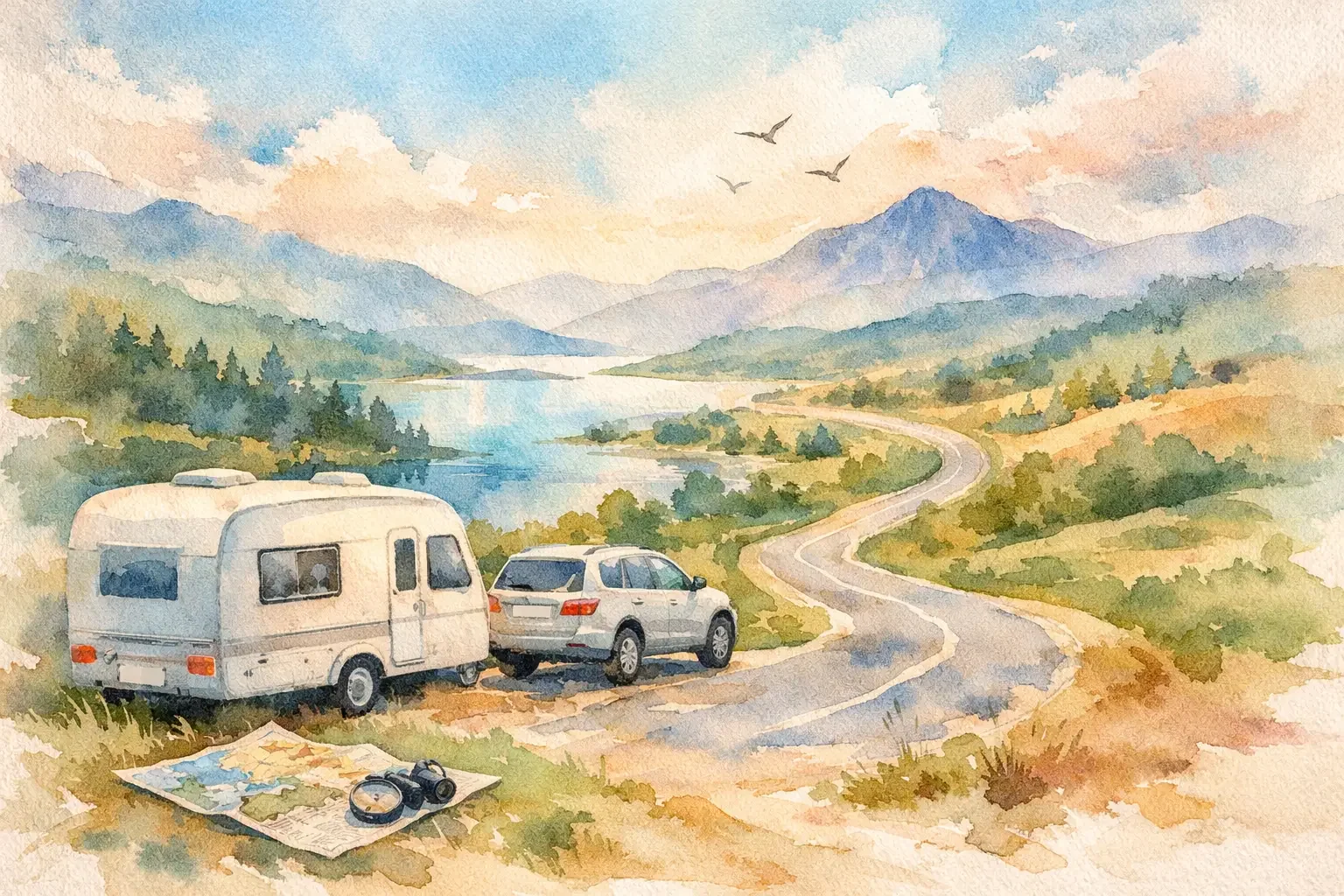
How To Plan Your First Caravan Route
Your first route with a caravan does not need to be heroic. In fact, if you're wondering how to plan first caravan route, the best answer is usually: make it shorter, slower and less clever than your sat nav thinks it should be.
A lot of new caravanners assume route planning is about finding the quickest way from A to B. It isn't. It's about finding the least stressful way to arrive with your shoulders still attached to your ears. That usually means trading a few extra miles for easier roads, simpler junctions and a site arrival that doesn't feel like an exam.
How to plan your first caravan route without overcomplicating it
Start with the purpose of the trip, not the map. Your first tow is not the time to prove you can cross three counties, reverse uphill through a farm gate and arrive in time to put the kettle on before dark. Pick a destination close enough that a wrong turn or a coffee stop doesn't derail the day.
For many beginners, somewhere within 60 to 90 minutes is ideal. That's long enough to get a feel for towing, but short enough that fatigue and concentration don't become the main event. If your nearest suitable site is even closer, that's not cheating. That's sensible.
Once you've chosen a site, look at the route as a driver towing a caravan, not as a solo motorist. A road that feels perfectly ordinary in the car can feel a bit different with extra length behind you, especially if it includes tight roundabouts, awkward right turns or busy town centres. None of that is automatically a problem, but your first trip is about building confidence, not collecting stories.
Choose easy roads first, not necessarily the shortest
For a first caravan route, major A-roads and motorway sections often make life easier. They tend to be wider, clearer and more predictable. That's boring in the best possible way.
The catch is that the shortest route suggested online may cut through villages, back roads or older urban areas to save ten minutes. Ten minutes is not worth squeezing past parked cars while a queue builds behind you and your brain starts offering unhelpful commentary.
When you compare route options, pay attention to the final stretch as much as the main journey. It's common for most of the route to be straightforward, then the last few miles turn narrow or fiddly. That doesn't mean the site is a bad choice, only that you should know about it in advance. Some sites have approach notes for exactly this reason. Read them. Site owners have usually seen enough caravans arrive to know which lane is fine and which one looks charming right up until you meet a tractor.
Watch for the bits that matter most
You do not need to obsess over every bend. You do need to notice a few things before you leave. Look out for low bridges, width restrictions, awkward fuel station access, major roadworks and any section where you'll need to thread through a town centre. Also check whether your arrival involves a right turn across traffic into the site entrance. Again, not always a problem, but much easier when you've expected it.
If a route includes one unpleasant section and a slightly longer alternative avoids it, take the alternative. This is not weakness. It is good route planning with fewer theatrics.
Timing matters more than people admit
A calm route at 11 am can be tiresome at 5 pm. Time of day changes everything, especially around cities, school runs and popular holiday routes.
For a first trip, aim for a daylight arrival with time to spare. Reversing onto a pitch is easier when you can actually see the pitch. So is spotting the water point, the hook-up bollard and the thing you've nearly backed into. Leave enough margin that a delay doesn't push you into a rushed final hour.
It also helps to be realistic about speed. You may be legally allowed to travel at certain limits depending on the road, but that doesn't mean every part of the journey will flow at that pace. Towing is slower by nature. Roundabouts, merging, wind, traffic and general first-trip caution all take time. Build that in and the day feels manageable rather than late before you've started.
Plan a stop, even if you might not need one
On a short first route, you may drive straight through. Even so, identify a sensible place to stop. Not every services layout is caravan-friendly, and not every petrol station is a good idea when you're towing.
Look for somewhere with easy access in and out, enough space to park without creating a diplomatic incident, and toilets if needed. If you're travelling a bit farther, a planned break helps concentration. Towing asks more of your attention than solo driving, especially when everything still feels new.
A stop is also useful if the weather turns poor or traffic becomes heavy. Pulling in for fifteen minutes can reset the whole day. Tea remains one of Britain's more practical technologies.
Use sat nav carefully, not blindly
Sat nav is useful, but it is not the final authority on what your caravan should do next. Think of it as one tool, not the family patriarch.
Before you travel, review the route on a map so you understand the broad shape of the journey. Which motorway junction are you taking? Where do you leave the A-road? Which village are you skirting rather than entering? That basic mental picture makes a big difference if the sat nav tries something odd or loses signal at exactly the moment you would prefer it not to.
If you use a caravan-specific or motorhome-friendly route planner, that can help highlight restrictions and more suitable roads. Even then, apply common sense. No device can fully judge current traffic, local driving conditions or your own confidence level.
Give yourself a simple arrival plan
The route is only half the job. Arriving well matters just as much.
Before you leave, know the site's check-in window and where the entrance actually is. That sounds obvious until you find yourself slowing on the wrong side of the road while the sat nav announces you have arrived somewhere near a hedge. If the site has specific arrival instructions, use them.
It also helps to have a rough idea of what you'll do once you get there. Park up, check in, find your pitch, then take a breath before worrying about levelling, hookup and all the rest. New owners sometimes feel they must perform a flawless military deployment the second they reach the gate. You don't. You just need to arrive safely and deal with one task at a time.
How to plan first caravan route when confidence is the real issue
Sometimes the route itself isn't the main problem. It's the noise in your head before you set off. That is very common, particularly if you've spent too long reading dramatic forum posts from people who write as if every B-road is a survival exercise.
The truth is more ordinary. Most first trips go perfectly well because people prepare sensibly, choose a manageable journey and drive with care. You do not need nerves of steel. You need a route that matches your current comfort level.
If you feel especially anxious, reduce variables. Travel in good weather if you can. Avoid Friday evening traffic. Pick a familiar region rather than somewhere completely unknown. If possible, do a short practice tow locally before the actual trip. Confidence usually grows from repetition, not from being told to stop worrying.
That same principle runs through a lot of the practical advice shared at CaravanVlogger - separate what truly matters from the noise, then make calm decisions rather than dramatic ones.
A sensible checklist before the day
The night before, confirm the route, the site address and your planned stop. Check the weather, particularly wind if you're new to towing. Make sure your mirrors, electrics and tyres are sorted, and that heavy items in the caravan are loaded sensibly and securely. None of this is glamorous, but glamour is in short supply when searching for a missing breakaway cable clip on a wet morning.
On the day, set off a little earlier than necessary. Not dawn-with-headtorch early, just enough that you are not starting already behind schedule. Keep your first route deliberately dull. Dull is underrated. Dull gets you there.
A good first caravan route is one that lets you learn without feeling under siege. If the journey is straightforward, the roads are reasonable and you arrive with enough headspace to enjoy the first evening, you've planned it well. That is plenty for trip one, and more than enough to build on for the next.
Where Next?
You can find more advice on how to Plan a uk caravan trip without the stress
If you’re looking for gaining confidence whilst towing, towing without the panic is the place to start. There is also a helpful towing confidence checker tool.
Need clearer caravan answers?
TalkWrench is where caravan questions get calm, experience-based explanations — without the noise, arguments, or guesswork.