
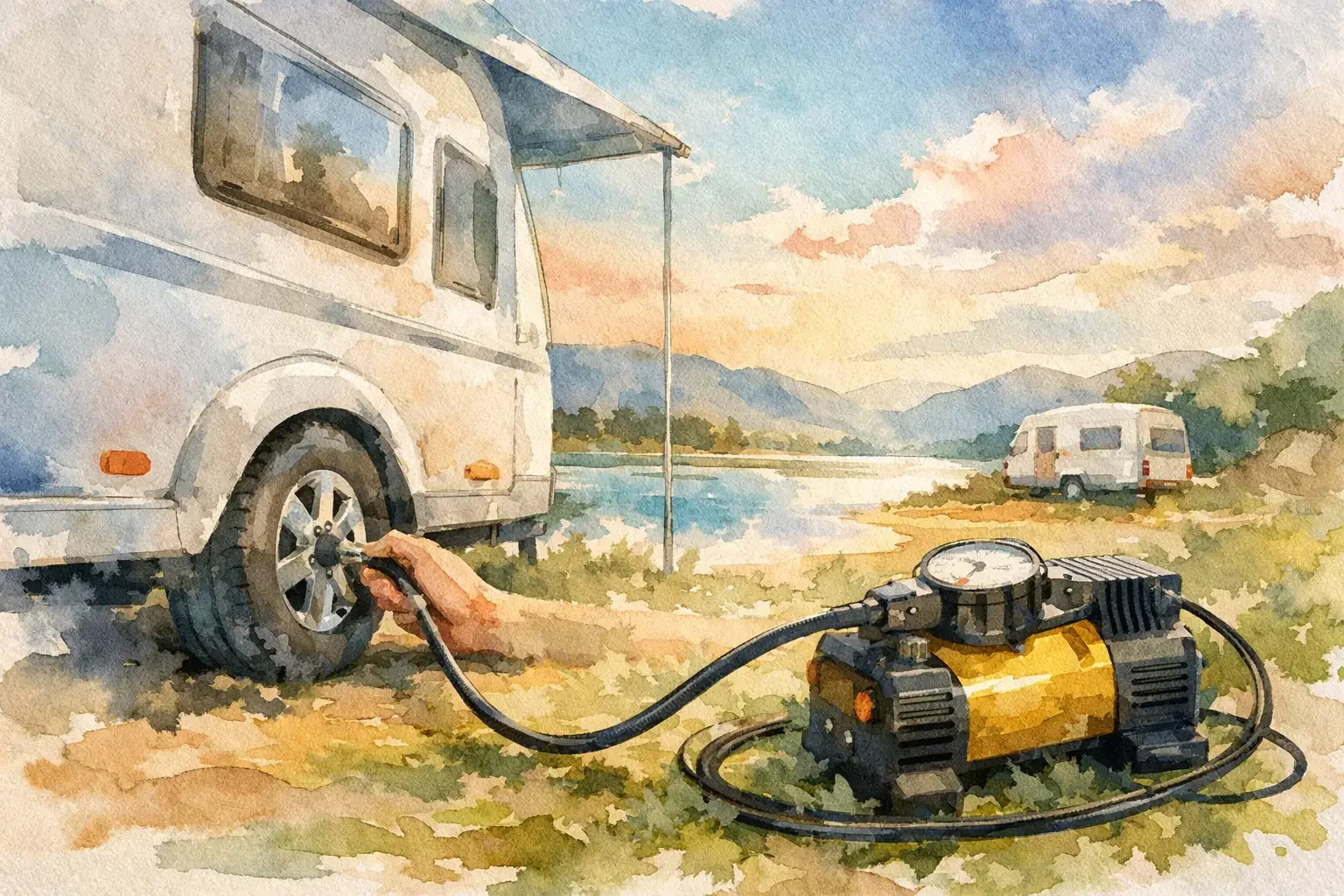
Best Caravan Tyre Inflator for Touring
A tyre looks fine right up until it isn’t, which is unhelpful when you’re parked on a wet pitch or about to leave for a long tow home. That is why choosing the best caravan tyre inflator for touring is less about gadget lust and more about making a mildly annoying job quick, accurate and drama-free.
The good news is that you do not need the biggest, flashiest compressor on the market. You need one that will reliably get a caravan tyre to the pressure you actually run, without taking ages, flattening your car battery or making you question your life choices at the side of a service station.
What makes the best caravan tyre inflator for touring?
For touring, the job is slightly different from topping up a bicycle or even a family hatchback. Caravan tyres often need relatively high pressures, and if your inflator struggles above 50 psi, that matters. Plenty of cheap inflators claim ambitious numbers on the box, then sound as if they are filing a complaint while barely moving the needle.
The best caravan tyre inflator for touring is usually a 12V compressor that can comfortably reach your required tyre pressure, has a clear gauge, a decent power lead and an air hose long enough to reach without a circus act. An automatic cut-off is helpful, but not essential if the gauge is accurate. A built-in light sounds a bit gimmicky until you are packing up before dawn.
Portability matters too. You are not setting up a workshop in the awning. You want something compact enough to live in the car or front locker, but not so tiny that it overheats after one tyre.
Start with your caravan’s actual tyre pressure
Before looking at brands or features, check the pressure your caravan tyres are supposed to be running. That information should come from the caravan manufacturer or tyre data for your specific setup. Do not guess, and do not assume the pressure stamped on the tyre sidewall is what you should be using in normal service. It usually is not.
This is where a lot of confusion starts. Someone online will say all caravan tyres must be run at one very high figure, someone else will declare anything lower is reckless, and before long a straightforward maintenance task has turned into a courtroom drama. Stick with the correct pressure for your caravan and loading conditions. Then buy an inflator that can reach it easily.
If your caravan tyres need 60 psi and your inflator only really copes up to 45-50 psi, you have bought a tool for feeling optimistic rather than solving the problem.
The features worth paying for
A decent pressure gauge is near the top of the list. If the gauge is vague, badly lit or obviously inaccurate, everything else becomes a bit academic. Some people still prefer to use a separate tyre pressure gauge for a final check, and that is not overkill. It is just sensible.
Duty cycle also matters, even if manufacturers do their best to make it sound thrilling. In plain English, this is how long the inflator can run before it needs to cool down. For touring, you want an inflator that can handle at least the car and caravan tyres without behaving like it needs a tea break after one wheel.
A screw-on connector often gives a better seal than a simple push-fit type, especially at higher pressures. It can be slightly more fiddly, but it usually leaks less air during connection and removal. That is a fair trade.
Cable length is often overlooked until you are trying to reach the far side of the outfit. A short cable and short hose can make a perfectly decent compressor irritating in real use. Check the stated length rather than relying on product photos, which are very optimistic things.
What to avoid when comparing inflators
The first trap is buying on maximum pressure alone. A compressor might claim 100 or 150 psi, but that tells you very little about how well it handles the 55-65 psi range many caravanners care about. Speed at useful pressures is a far better indicator.
The second trap is assuming tiny equals convenient. Very compact inflators are easy to store, but some are painfully slow on larger tyres and can get hot quickly. If you only ever top up a small amount, that may be fine. If you want something genuinely useful on tour, go one step sturdier.
Battery-powered inflators can be handy, but they are not automatically the best choice for caravanning. Some cordless units are excellent for cars and general use, yet struggle with sustained higher pressures or have limited runtime. They are brilliant until the battery is flat, at which point they become an expensive paperweight with a nice handle.
That does not mean cordless is wrong. It means it depends on how you tour. If you like a grab-and-go tool for quick checks and already own batteries in the same platform, fair enough. If you want dependable performance for caravan tyres on longer trips, a good 12V unit is often the safer bet.
12V, cordless or mains - which is best?
For most people, a 12V inflator is the most practical option. It is easy to carry, works from the car, and is usually powerful enough for touring needs without costing a fortune. This is the sensible middle ground, which is not always exciting but is often where the best decisions live.
Cordless models are convenient and tidy. No cable management, no need to reach the car socket, and very useful around home as well as on site. But for caravanners, convenience needs to be balanced against power and battery life. Some premium cordless inflators are up to the job, but many compact ones are better suited to occasional topping up than repeated higher-pressure use.
Mains compressors are excellent in a driveway or storage yard. If you keep the caravan at home and want the easiest, quickest inflation before a trip, they can be superb. They are just less useful once you are actually touring, unless you particularly enjoy packing a compressor the size of a reluctant badger.
12v cordless inflator on Amazon
Recommended approach rather than blind brand loyalty
There is no single inflator that suits every caravanner. A couple with a lightweight tourer doing short UK breaks has different needs from someone towing a larger twin-axle on long continental trips. So rather than pretending there is one magical answer, it helps to think in use cases.
If you want the best all-round option for most tours, choose a well-reviewed 12V compressor from a known automotive brand with a clear digital or analogue gauge, auto stop if possible, and confirmed capability at your caravan’s required pressure. That will suit most owners perfectly well.
If you already use a cordless tool system and can get a compatible inflator with proven high-pressure performance, that can be a very good touring solution. Just be realistic about battery charge and carry a backup plan.
If your main concern is pre-trip maintenance at home, a small mains compressor may actually be the better buy, even if it is not the most portable. Not every purchase has to be optimised for every scenario.
A few product types that usually work well
Heavy-duty 12V compressors from established car accessory brands tend to be the sweet spot. They are built for vehicle tyres rather than pool toys, which is always encouraging. Mid-sized digital inflators are often easier for beginners because the target pressure is clear and the auto-stop reduces guesswork.
Compact emergency inflators can work, but they are best treated as emergency tools first and touring tools second. They are fine to keep in the boot for reassurance, but less ideal if you expect to use them regularly on caravan tyres.
Workshop-style compressors are excellent for speed and confidence at home, but most touring caravanners will not want the size, weight or storage faff on the road.
How to use an inflator without making life harder
Check pressures when tyres are cold, or as close to cold as is practical. If you have just towed for an hour and then start adjusting pressures on a warm tyre, your readings will not be as reliable.
Use the inflator as part of a simple routine before each trip. Check the car, check the caravan, and check the spare if you carry one. This is one of those jobs that sounds boring because it is boring, but it is also exactly the sort of boring habit that prevents exciting problems later.
It is also worth testing your inflator at home before relying on it on tour. That sounds obvious, yet many of us have discovered a missing fuse, a cable too short or a gauge we do not trust at the least convenient moment. Better to find that on the driveway with a cup of tea nearby.
So, what should you actually buy?
If you want the calm, practical answer, buy a quality 12V inflator that comfortably exceeds your caravan’s required tyre pressure, has a trustworthy gauge, and is not so flimsy that you dread using it. Ignore inflated marketing claims, check real-world suitability, and do not overpay for features you will never use.
That is usually the best caravan tyre inflator for touring - not the loudest one, not the cheapest one, and certainly not the one with the most heroic packaging. Just the one that works when you need it to, which is really the standard most touring kit ought to meet.
If you prefer this sort of measured, no-fuss guidance, CaravanVlogger covers plenty more at https://caravanvlogger.co.uk. The aim is always the same: less second-guessing, more confident touring.
A good inflator will not transform your holiday, and that is rather the point. It quietly removes one more source of avoidable stress, leaving you free to get on with the far more serious business of deciding whether the kettle goes on before or after the steadies are down.
What Do I Use?
I bought a 12v tyre inflator from Amazon the GSPSCN 6X Faster Inflation Tyre Inflator Heavy Duty Double Cylinders with Portable Bag
It’s been reliable and I bout it in 2022.
👉 Most caravanning advice is either overcomplicated… or just wrong.
Join the CaravanVlogger newsletter for:
✔ Real-world towing advice
✔ Setup tips that actually matter
✔ The stuff no one explains properly