
Reverse a Caravan Calmly: Beginner Steps
You know the moment. You’ve arrived, you’re feeling quietly pleased with the towing so far, and then the pitch appears like a narrow stage - with an audience. Suddenly the steering wheel feels connected directly to your self-esteem.
This caravan reversing guide for beginners is here to lower the drama. Reversing isn’t a mysterious talent some people are born with. It’s a set of small, learnable habits that make the outfit predictable, slow, and safe. The win isn’t looking slick. The win is not damaging anything, not rushing, and finishing the manoeuvre with your blood pressure still in the human range.
What actually makes reversing a caravan hard?
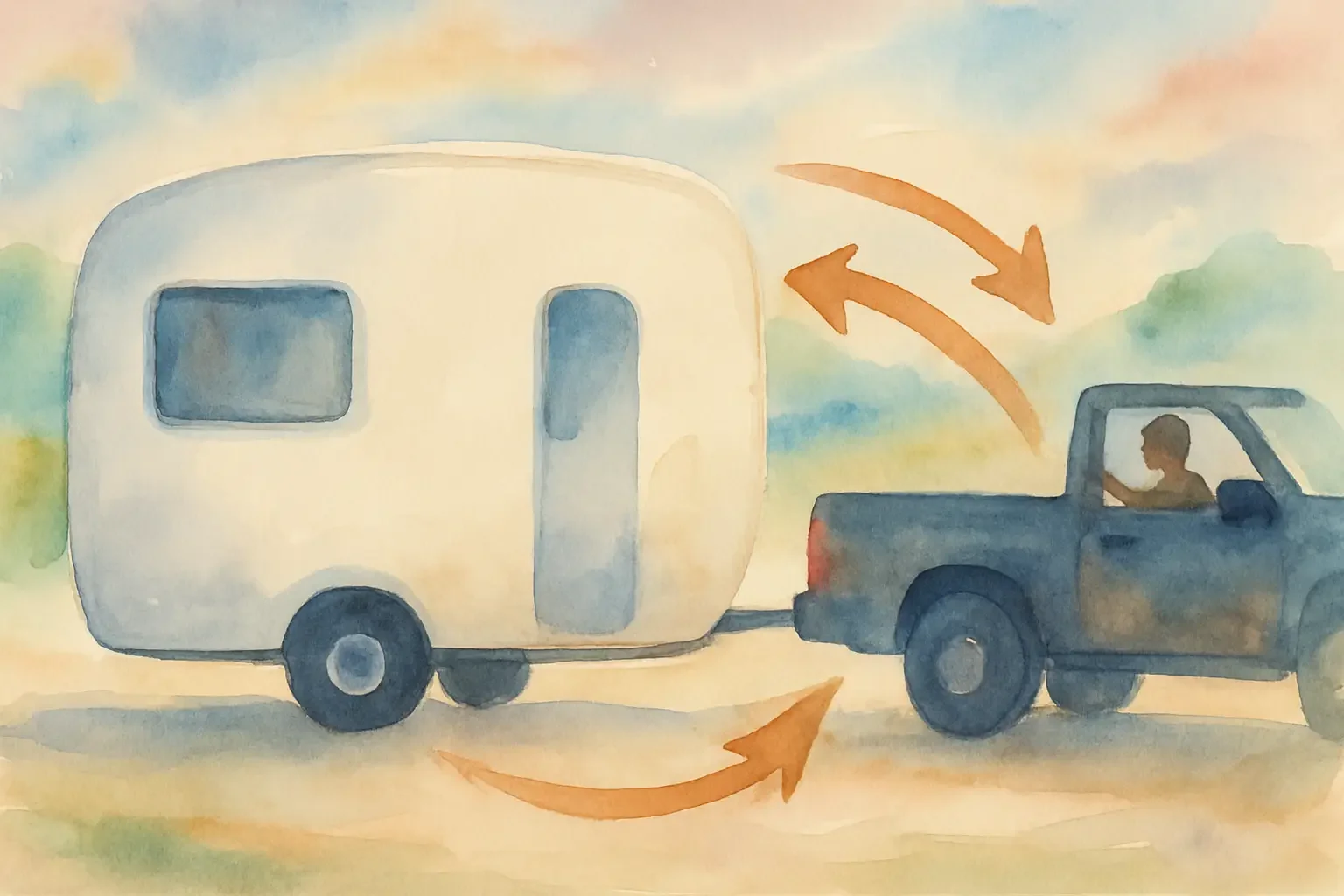
Most people think the difficulty is steering “the wrong way”. That’s part of it, but the real challenge is that you’re controlling a hinge. Your car goes one way, the caravan reacts a moment later, and if you wait until it looks wrong, you’re already behind.
The second challenge is scale. A small steering input at the car becomes a big change at the caravan’s rear - especially if your tow car has a short wheelbase. That’s why beginners tend to over-correct, then over-correct the over-correction, and end up doing a sort of three-point turn across half of Dorset.
Finally, reversing is often done under pressure: tired, hungry, on a slope, with the road behind you. Technique matters, but judgement matters more. You’re allowed to choose a different approach, stop, reset, or ask someone to hold traffic for a moment. That’s not failure. That’s competence.
Set yourself up before you move an inch
A good reverse starts with a slow walk. Before you get back in the driver’s seat, get out and look at the space as if you’re planning to push the caravan in by hand.
Notice the things that don’t move (posts, bollards, rocks, water taps) and the things that do (kids, dogs, cyclists, helpful strangers who wander into your blind spot to “guide” you). Check the surface too. Gravel changes braking. Wet grass changes traction. A slope changes how quickly the outfit wants to swing.
If you’ve got a motor mover, decide whether you’re using it now. There’s no moral victory in reversing on the car when the mover is the safest option for a tight pitch. Equally, if you want to practise reversing properly, do it when there’s room and time.
One more thing - agree on signals if you’re using a guide. Simple is best: stop, left, right. No interpretive dance. And decide whose left and right you mean: yours in the driver’s seat, not theirs facing you.
The core principle: control the caravan, not the car
When reversing, your job is to place the caravan, not to point the car neatly. The car is just the handle.
Here’s the beginner-friendly way to think about steering inputs: small and early. If you turn the wheel a quarter turn and wait, you’ll see the caravan begin to respond. If you spin the wheel like you’re avoiding a wasp, you’ll create an angle faster than you can recover.
A useful mental model is to “aim the caravan’s rear corner” towards where you want it to go, then keep the angle gentle. The gentler the angle, the longer you have before it becomes a jack-knife situation.
Mirrors, head movement, and the temptation to look everywhere
Use your door mirrors as your primary view. Not the rear-view mirror - that’s mostly a view of your own uncertainty.
Set your mirrors so you can see a slice of the caravan’s side and the ground next to it. You’re tracking two things: where the caravan is going and how close it is to obstacles. If you can’t see the caravan at all in a mirror, you’re guessing.
When reversing, pick the mirror that shows the inside of the turn and give it more attention. If you’re reversing with the caravan turning to the left, your left mirror tells you most about clearance and angle. The other mirror still matters, but it’s often confirming you’re not clipping something wide.
Don’t be afraid to physically lean forward and adjust your viewpoint. The goal is information, not posture.
Speed: slower than you think you need
Reversing a caravan should feel almost boring. If it feels brisk, it’s too fast.
Use the car’s idle speed where possible and cover the brake. The slower you go, the more time you have to notice the angle building and correct with tiny inputs. Speed hides mistakes until they’re expensive.
If you’re in an automatic, be especially disciplined. Autos can creep more eagerly than you think on a slope. If you’re in a manual, use clutch control carefully and avoid riding it for ages - better to stop, reset, and do short movements than cook your clutch to prove a point.
A simple step-by-step reverse onto a pitch
Let’s assume a typical UK site pitch: you approach, stop slightly past it, then reverse in.
Start by positioning the outfit so you have space on the side you want the caravan to swing towards. If the pitch is on your left, you generally want to be a touch to the right before you start reversing. Not halfway across the access road - just enough to give the caravan room.
Begin reversing dead straight for a short distance. This is where beginners often rush the turn. Going straight first gives you a stable starting point and helps you judge how quickly the caravan responds.
Then introduce a small steering input to start the caravan turning towards the pitch. Watch the inside mirror and let the caravan’s angle develop gradually. When you see the caravan’s rear beginning to line up with the pitch, unwind the steering towards straight to follow it in.
If the caravan starts to “bend” too much (the angle tightens quickly), stop. Pull forward to straighten. Try again with a smaller initial input. This is normal. Resetting is not a sign you can’t reverse - it’s how you avoid the classic beginner error of pushing on until you physically cannot recover.
The one correction that saves most beginners
If things feel like they’re getting away from you, the fix is usually not more steering. It’s less angle.
Stopping and pulling forward a metre or two to straighten the outfit does two things. It reduces the caravan’s angle (making it controllable again) and it resets your mirrors so you can see properly. Beginners often try to rescue a steep angle by steering harder, which just increases the hinge and makes the next second more dramatic.
So give yourself permission to do a calm reset early. It’s quicker than wrestling it.
Tight entrances, narrow gates, and the “S” problem
Some sites and storage yards require an S-shaped reverse: you need the caravan to swing one way, then the other, to line up.
The trick is to treat it as two separate moves with a pause between them. Create the first gentle angle, stop when the caravan is positioned to begin the second, then unwind and create the opposite gentle angle. If you try to do it in one flowing manoeuvre at speed, you’ll lose track of which mirror matters and you’ll end up chasing the caravan.
If there’s a gate post or wall involved, prioritise clearance over elegance. You can always take an extra shunt. You can’t un-scratch a post.
When to use a spotter (and how to avoid the classic arguments)
A spotter is brilliant for clearance and obstacles. They are not brilliant for steering advice if they’re stressed and you’re stressed.
Ask your spotter to stand where you can see them in a mirror, not directly behind the caravan where they disappear. Agree that “stop” means stop immediately, no debate. And if you lose sight of them, stop until you find them again.
If you’re both new, keep the roles simple: you steer and brake, they watch distances. Too many instructions becomes noise.
Practise without the pitch audience
The fastest way to improve is a quiet car park or an empty corner of a storage yard, with cones or markers you don’t mind bumping. Practise three things: reversing straight, introducing a small angle and holding it, and doing a stop-and-pull-forward reset.
Ten minutes of low-stakes practice teaches your hands what a quarter turn feels like and teaches your eyes what “too much angle” looks like before it becomes a problem.
If you want more calm, experience-led towing guidance beyond reversing, CaravanVlogger has a load of it at https://caravanvlogger.co.uk.
A few trade-offs worth knowing
There isn’t one perfect method because outfits differ. A long caravan responds more slowly but can be easier to control once it’s moving. A short caravan responds quickly and can feel twitchy. A long-wheelbase tow car often makes reversing calmer; a short-wheelbase car can feel more immediate.
Weather matters too. Wind can nudge the caravan’s side as you reverse, especially on open hardstanding. Wet grass can stop you mid-manoeuvre, which is when people add throttle and everything happens at once. If traction is marginal, slow down even more and consider whether a mover is the safer choice.
And yes, some people swear by putting a hand at the bottom of the steering wheel so your hand moves the way the caravan goes. If that helps you, use it. If it makes your brain melt, ignore it. Your goal is consistent, small inputs - not loyalty to a trick.
The closing thought you actually need
Reversing a caravan isn’t a personality test. It’s just a slow manoeuvre with high consequences if you rush it. Give yourself space, make tiny changes early, stop sooner than you think, and reset without embarrassment - you’ll look like the calm, capable caravanner long before you feel like one.
Need clearer caravan answers?
TalkWrench is where caravan questions get calm, experience-based explanations — without the noise, arguments, or guesswork.