
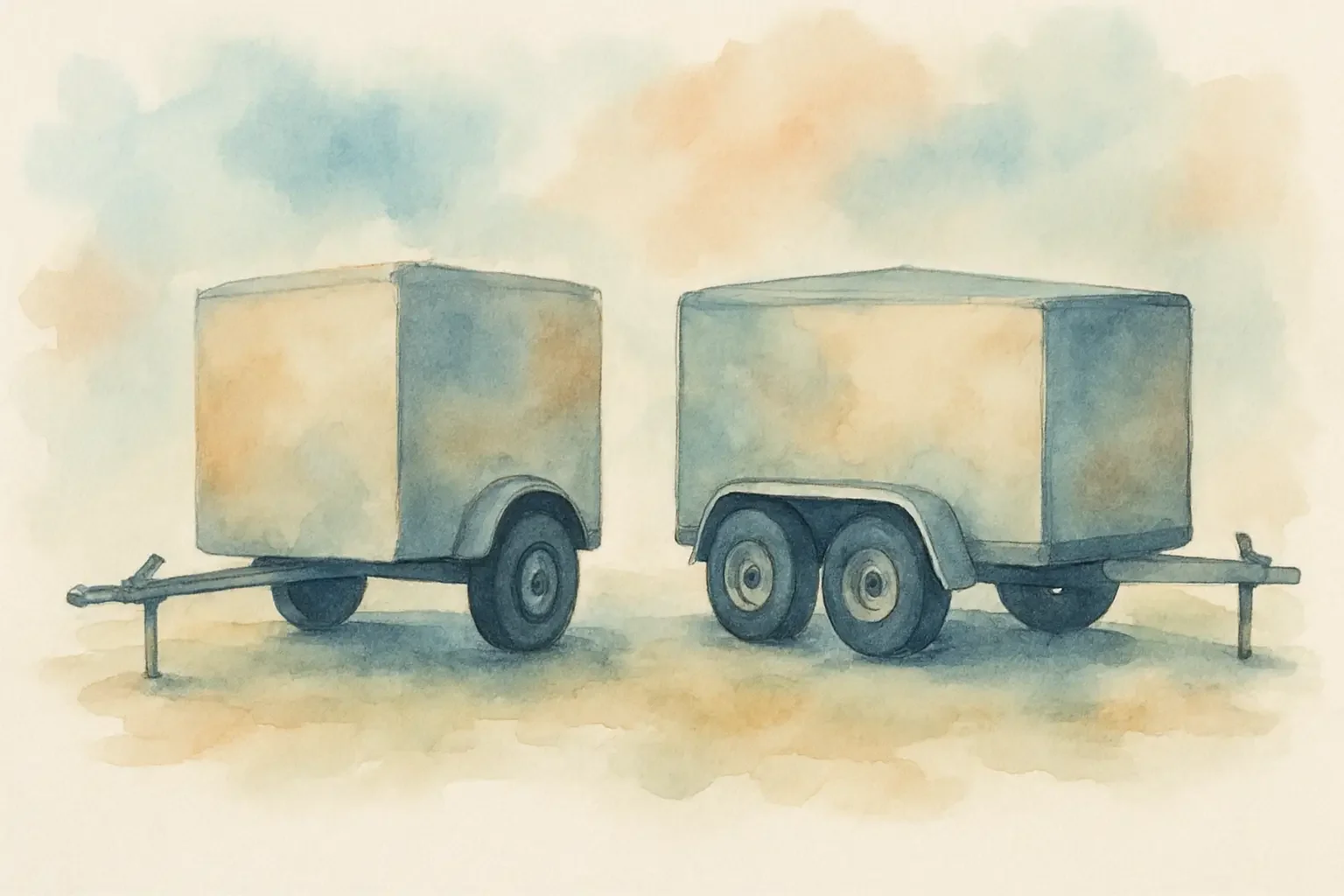
Single Axle vs Twin Axle: Which Caravan Suits You?
Part of the Caravan Ownership – What Actually Matters hub
You know the moment. You’re stood on a dealer forecourt (or scrolling listings at midnight), and you spot it - the same layout you like… twice. One on a single axle, one on a twin. Suddenly it feels like you’re not choosing a caravan, you’re choosing a personality.
Let’s bring the temperature down. The single axle vs twin axle decision isn’t about bravery, or being a “proper” tourer. It’s about how you actually travel, where you go, what you tow with, and how much faff you’re willing to tolerate for the benefits you gain.
Single axle vs twin axle: what changes in the real world?
An axle choice shifts three practical things: how the caravan behaves on the road, how it behaves at walking pace (manoeuvring and pitching), and how it behaves in ownership (tyres, servicing, wear and tear).
A twin can feel more settled at motorway speeds, particularly with longer-bodied caravans. Not because it’s magical — but because the mass is distributed differently. A single axle will usually be easier to position by hand and a bit more forgiving on tight drives and small pitches. Neither is “safe” by default and neither is a guaranteed cure for nerves - but each can make certain parts of caravanning feel calmer.
The catch is that the benefits and drawbacks swap places depending on your tow car, your storage, and your typical trip.
Stability and towing confidence: what’s actually going on?
A lot of the mythology around twins comes from a simple truth: two axles spread the load, and the caravan has a longer wheelbase. That can reduce pitching and can make the outfit feel steadier when buffeted by HGVs, crosswinds, or a hasty overtake from someone late for a meeting.
But stability is not an axle badge. It’s a whole-system thing: noseweight, loading, tyre condition and pressures, tow car match, speed, and driver inputs. A well-matched, correctly loaded single axle can feel beautifully composed. A badly loaded twin can still make your palms sweaty.
Where twins often help newer towers is not in magic stability, but in how they damp some of the little wobbles that come from rough surfaces and long bodies. If you’re looking at bigger, longer caravans - the sort with a fixed island bed and a proper end washroom - a twin axle can make that size feel less “back there doing its own thing”.
Single axles, meanwhile, can feel more responsive to steering corrections. That’s not inherently bad, but it can magnify the tendency to over-correct when you’re tense. If you’re the type who grips the wheel like it’s trying to escape, the best upgrade isn’t automatically an extra axle - it’s learning what correct loading feels like and building calm routines.
Weights and payload: the bit that quietly decides for you
Here’s the unglamorous part: many twin axles are simply heavier caravans. That often means higher MTPLM (maximum technically permissible laden mass) and more generous payload, which is genuinely useful if you tour for weeks, carry an awning, or travel with bikes and all the “just in case” kit.
But heavier caravan usually means heavier tow car requirement. The axle count itself doesn’t set the weight, but in the UK market twin axles are commonly paired with higher overall masses. So the decision is sometimes made for you by what your car can legally and sensibly tow.
If your current car is already near its comfortable limit, moving from a single axle to a twin of similar layout might not be a side-step - it might be a weight jump. That’s when people get caught out: they fall in love with the floorplan and only later realise they’ve also bought a tow car problem.
If you’re unsure, do the boring checks early: plated weights, your car’s towing limit, and whether you’re realistically going to load the caravan to its maximum. It’s not about passing a test on the internet. It’s about avoiding that horrible “we’ve bought it… can we tow it?” feeling.
Manoeuvring and pitching: the day-to-day reality
This is where single axle caravans earn a lot of quiet loyalty. On a typical UK site pitch, the caravan will be moved at walking pace more times than it will be towed at 60 mph: nudged onto a leveller, edged back to the peg, shifted to get the awning sitting square.
A single axle tends to pivot more readily. That’s good when you’re pushing it by hand or using a mover to tuck it into a tight space. It often feels like it goes where you point it.
A twin axle can feel more reluctant. It tracks straighter, which is lovely at speed, but it can also mean more effort to rotate the caravan on the spot. If you have a narrow driveway with a turn, or you store at home and have to thread it past a wall, a twin can turn a five-minute job into a small workout.
Motor movers help massively either way. But here’s the bit people don’t always mention: a twin axle can scrub tyres when you pivot tightly. That’s not a moral failing, it’s geometry. The tyres want to roll, but you’re asking them to slide sideways a bit as the caravan rotates.
So if you regularly have to spin the caravan sharply - tight storage compound lanes, awkward gates, narrow cul-de-sac approaches - tyre scrub becomes a real ownership cost, not just a forum talking point.
Tyres, servicing and running costs
A twin axle has four tyres. A single axle has two. That’s the most straightforward maths in caravanning, and somehow the easiest to forget when you’re negotiating on price.
Four tyres cost more to replace, and you’ll replace them more often than mileage alone suggests because age matters. You may also have two brakes, two sets of hubs, and generally more components to inspect. None of this should frighten you - it’s just budget reality.
The flip side is that twins can distribute load more gently across each tyre, which can reduce stress. But that doesn’t erase the practical truth: more rubber, more cost.
If you do lots of slow-speed manoeuvring, tyre scrub can accelerate wear on twin axle tyres, especially the ones taking the brunt of the pivot. It’s not always dramatic, but it’s worth inspecting sidewalls and tread more routinely.
Pitches, access roads and “will it fit?”
UK touring often involves narrow lanes, tight site entrances, and pitches that were designed when caravans were shorter and everyone owned a kettle that didn’t need its own cupboard.
A twin axle is usually longer overall. That affects two things: how easily you can get onto and off pitches, and whether a given pitch length is comfortable with your van and car.
It’s rarely impossible, but it can add mental load. You might find yourself declining certain sites or choosing specific pitch types more often. If your caravanning happy place is small CLs, farm sites, and tucked-away spots with grass pitches and a view, you’ll want to be honest about the access.
If your happy place is bigger commercial sites with good roads and generous hardstandings, a twin can be utterly painless.
When a single axle is often the better call
If you tour frequently and value simplicity, a single axle is hard to beat. It’s typically lighter, often easier to match to a wider range of tow cars, and generally less of a wrestling match at home or on storage.
It also makes sense if your drive is tight, you have to push by hand sometimes, or you want to keep tyre and servicing costs modest. For many UK caravanners, a well-sorted single axle is the sweet spot: stable enough, manageable enough, and less likely to turn pitching into a three-person committee meeting.
When a twin axle comes into its own
If you’re looking at larger, heavier caravans - especially long-bodied models where you can feel the mass - a twin axle can bring a calmer, more settled tow. That’s particularly true for long motorway runs, touring abroad, or anyone who regularly drives in windy coastal areas.
Twins also shine when payload matters and you’re not constantly dancing around the edge of your limits. If your touring style involves longer stays, more kit, and less “minimalist weekend away”, the extra carrying capacity (and the way the van feels when loaded) can be reassuring.
And if you already have the right tow car and you’re comfortable with the storage and access realities, a twin can feel like an upgrade in ease rather than a complication.
A calmer way to choose (without the internet shouting)
If you’re stuck on single axle vs twin axle, stop trying to choose the “best” and start choosing what reduces your specific friction.
If your biggest stress is motorway stability, look hard at tow car match, loading habits, and whether the caravan size is pushing you into the twin axle category anyway. If your biggest stress is getting it onto your drive without taking out a flowerbed (or your pride), weight and manoeuvrability may matter more than the promise of extra plantedness at speed.
One practical trick: picture your last three trips. Not the Instagram bits - the actual bits. The narrow turn into the storage compound, the levelling on a slope, the windy A-road, the late arrival when you’re tired. Which axle choice would have reduced the awkward moments?
If you want more confidence-building guidance on towing, weights and the stuff that actually moves the needle, CaravanVlogger has a calm library of practical help at https://caravanvlogger.co.uk.
The decision you can live with
Choose the axle setup that makes you feel quietly capable on your most typical day, not the one that sounds impressive in a comment thread. Caravanning is supposed to lower your blood pressure, not turn every departure into a performance.
Where to Go Next
If this page resonates, you may also find reassurance in:
Need clearer caravan answers?
TalkWrench is where caravan questions get calm, experience-based explanations — without the noise, arguments, or guesswork.