
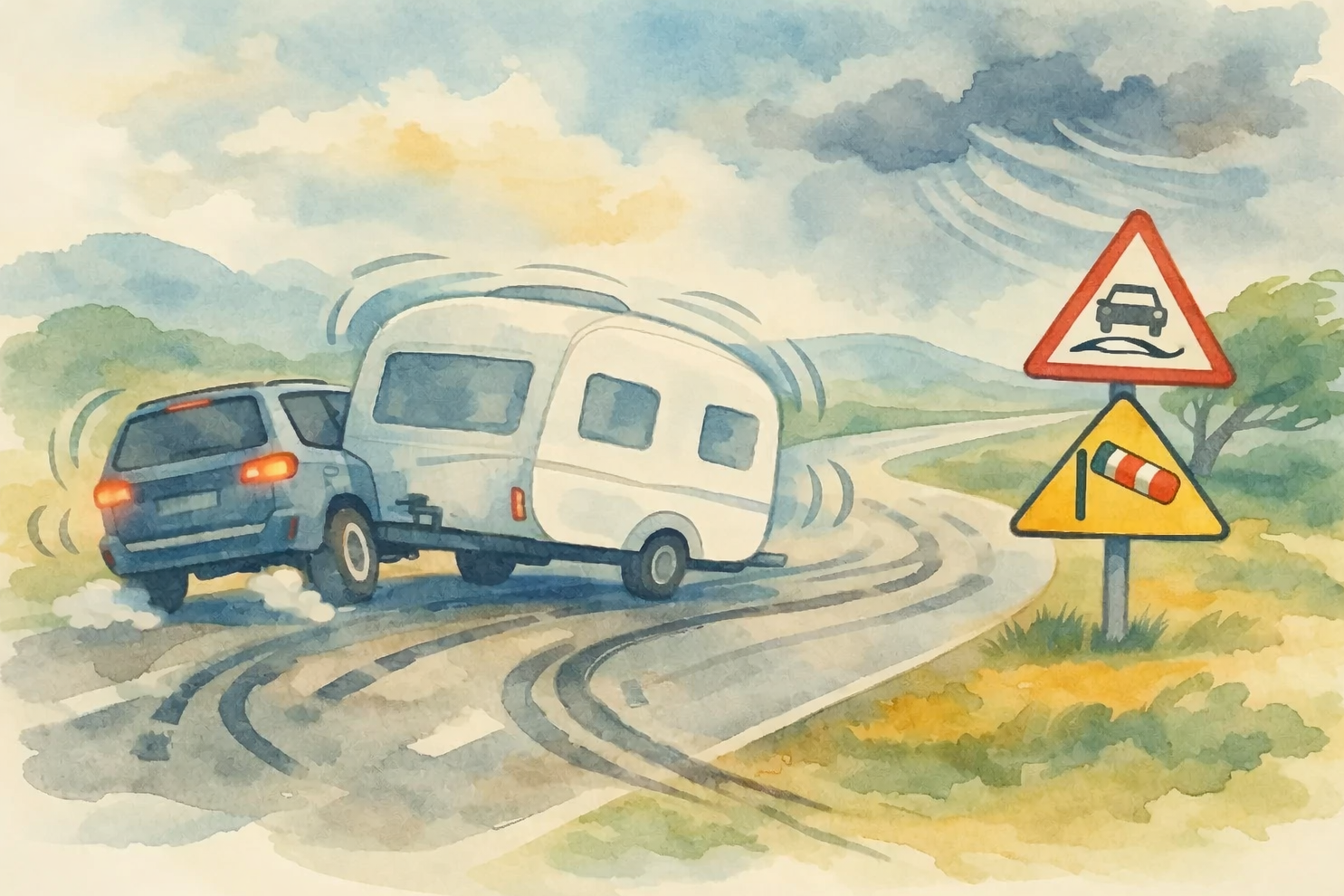
What Actually Causes Snaking?
Snaking is one of those towing fears that looms large — even for people who’ve never experienced it.
It’s often described as something that:
Happens suddenly
Comes out of nowhere
Means you’re doing everything wrong
In reality, snaking has clear causes, and it almost never appears without warning.
Let’s calmly explain what’s really going on.
First, what snaking actually is
Snaking is a side-to-side oscillation of the caravan that:
Starts small
Can grow if conditions allow
Feels unsettling because it feeds back into the tow car
It’s not random.
It’s not bad luck.
And it’s rarely caused by a single factor on its own.
Snaking happens when stability is gradually reduced, then something gives it a push.
The most common causes (in plain English)
🚦 Speed
Speed is the biggest amplifier.
At higher speeds:
Small movements grow faster
Corrections become sharper
Wind effects increase
Reaction time shrinks
An outfit that feels calm at 50mph can feel very different at 60mph — even if nothing else changes.
⚖️ Low nose weight
Too little nose weight allows the caravan to:
Feel light on the hitch
React more easily to disturbances
Start oscillating rather than settling
Low nose weight is one of the most frequent contributors to snaking.
This links directly to the nose-weight page in this hub.
📦 Poor loading
Loading affects how the caravan wants to move.
Common issues:
Heavy items at the rear
Weight placed high up
Trying to “balance” by guesswork
Poor loading doesn’t usually cause instant snaking — it reduces stability margins, making snaking easier to trigger later.
🌬️ Wind and overtakes
Strong crosswinds and HGV overtakes create a sideways force.
A stable outfit:
Absorbs the push
Settles quickly
An unstable outfit:
Reacts strongly
Feeds movement back into itself
This is why snaking often starts:
On motorways
While being overtaken
On exposed roads
🛞 Tyres and suspension
Tyres and suspension quietly influence stability.
Issues include:
Under-inflated tyres
Old or mismatched tyres
Tired suspension on the tow car
Overloaded rear axle
These don’t cause snaking directly — but they reduce control when something else starts it.
What doesn’t usually cause snaking
This matters just as much.
Snaking is rarely caused by:
Being a few kilos over or under a guideline
A single gust of wind on its own
One small steering input
“Bad caravans”
It’s usually the combination of factors that matters.
The moment snaking starts (this is key)
Snaking often begins as:
A gentle weave
A feeling that the caravan isn’t settling
A need for repeated steering corrections
The mistake many people make is trying to steer it out.
Small steering inputs can accidentally:
Add energy to the movement
Increase oscillation
Make things worse
This is why calm, correct reactions matter — and why prevention is better than cure.
Why modern outfits are usually more stable than you think
Modern caravans and tow cars benefit from:
Better chassis design
Improved suspension
Wider tracks
Electronic stability systems
This means:
Most outfits are naturally stable when set up sensibly
Snaking usually needs multiple factors to line up
Good setup quietly does most of the work for you
The calm takeaway
Snaking isn’t a mystery.
It’s usually the result of:
Too much speed for the conditions
Reduced stability from loading or nose weight
An external trigger like wind or overtaking
Remove one or two of those factors, and snaking often never gets started.
Understanding this replaces fear with control — which is exactly the point of this hub.
How this fits into Towing Without the Panic
This page connects directly to:
Together, they explain not just what happens — but why.
Where next?
If snaking worries you most, the next helpful read is:
👉 Do I Need ATC or Sway Control?
It explains what these systems can — and can’t — do calmly and realistically.
Head back to Towing Without The Panic to choose another topic in the series
Need clearer caravan answers?
TalkWrench is where caravan questions get calm, experience-based explanations — without the noise, arguments, or guesswork.