
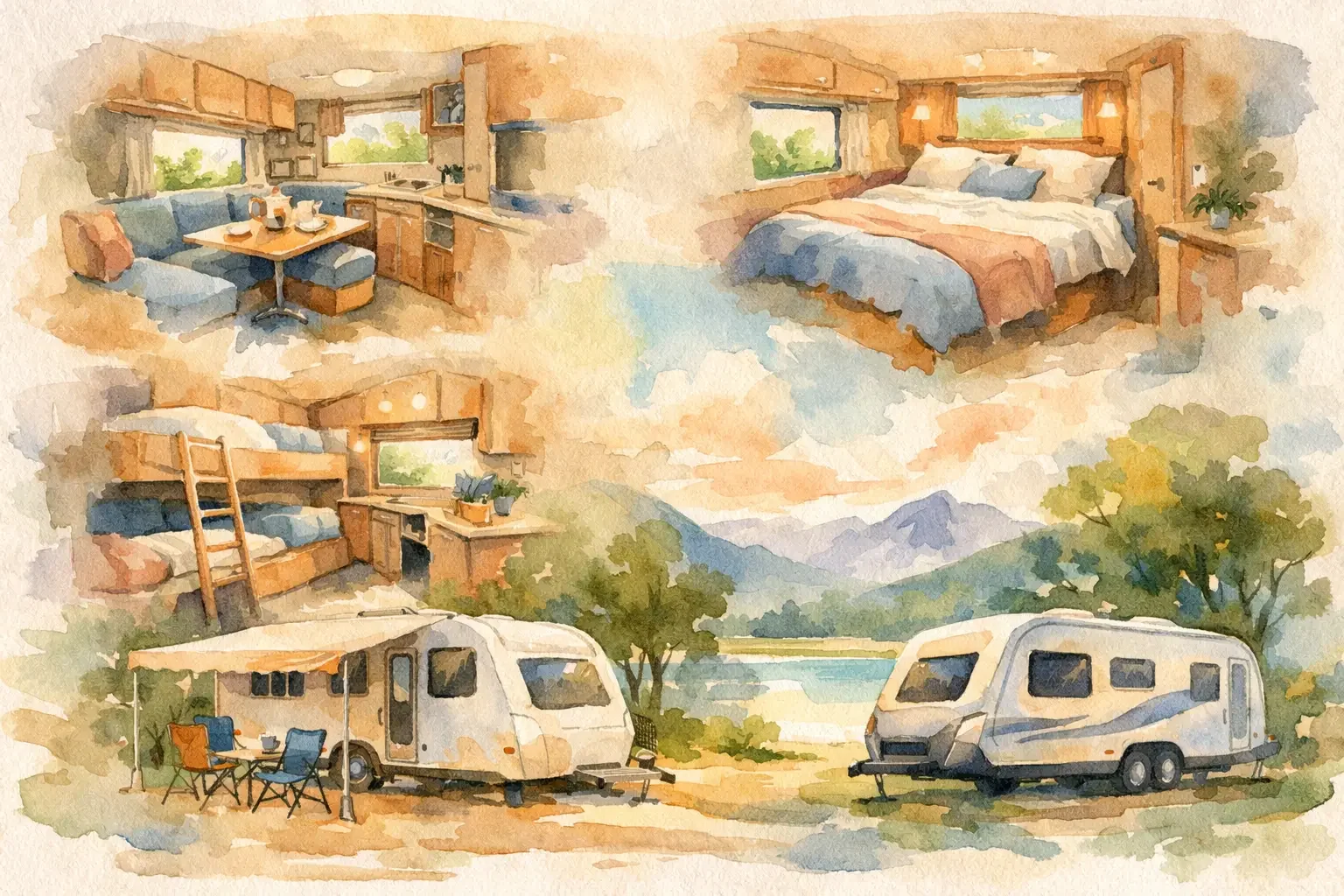
Caravan Layouts That Work for Your Touring
The wrong caravan layout rarely reveals itself on a bright Saturday at the dealer, when everything is clean, the cushions are plumped and nobody is trying to make a cup of tea while another person needs the loo. Caravan layouts make their case on a wet Tuesday in Wales, after a long tow, when the dog is damp, the children are hungry and somebody has left their toothbrush in the car.
That is not a reason to overthink the decision until the season has passed you by. It is simply why a layout should be chosen around how you actually tour, rather than the brochure photo that makes the biggest caravan look like a boutique hotel on wheels.
Start with the touring life you already have
Before comparing bed shapes and washroom doors, think about your usual trips. A couple spending weekends on full-service sites will live very differently from a family doing fortnight-long summer holidays, or two people touring for months at a time.
Ask yourselves what happens first thing in the morning, where wet coats will go, whether you eat inside often, and how much you mind making a bed each night. There is no prize for buying a fixed bed if you would rather have a huge lounge, and no medal for making up cushions daily if it quietly irritates you by day three.
Also be honest about the caravan's overall size. A layout may be perfect on paper, but a longer, heavier tourer can affect towing comfort, storage at home and the choice of pitches. Check weights and towing suitability separately from the floorplan. A clever interior does not make an unsuitable outfit sensible.
Caravan layouts: the choices that shape daily life
Most layouts are variations on a few familiar ideas. The best one is not universally best. It is the one that creates the fewest annoyances for your crew.
Front lounge layouts
A traditional UK caravan places two parallel sofas at the front. They provide a genuinely useful daytime seating area and can usually convert into either two singles or a large double bed.
For couples, this remains a strong all-round choice. The front lounge feels open, gives you room to put your feet up and often lets you sit at opposite ends without pretending you are both comfortable on one dinette seat. It is also handy when friends call in at the site.
The compromise is bed-making. Some people become impressively efficient at it; others find it turns a relaxing evening into a daily furniture-moving exercise. Try it in the showroom if you can. Do not just glance at the cushions and assume it will all fall into place by magic. It will not.
Fixed-bed layouts
A fixed bed is appealing for obvious reasons: you can leave it made up. After a long drive or a busy day out, that is a small luxury with a very real effect on how relaxed touring feels.
French beds run lengthways against one wall and tend to save space, though the person sleeping on the wall side may need to climb over their partner. Island beds are easier to access from both sides, but usually demand a longer caravan and can reduce the usable space elsewhere. Transverse beds sit across the rear or middle of the caravan and can offer a good-sized sleeping area, although access around the foot of the bed may be tight.
Look beyond the mattress. Can you open wardrobes, get changed and reach the washroom without performing a polite sideways shuffle? A fixed bed that makes the bedroom awkward is still a fixed bed, just with more choreography.
Twin single beds
Twin singles are among the most practical caravan layouts for many couples. They are easy to get into, avoid the climbing-over issue and often leave a clear central route through the caravan. They can also suit caravanners who sleep better with their own space but would rather not make that a major talking point.
These layouts commonly include a rear washroom, creating a useful dressing area. The trade-off is that twin beds can take up more floor space than a double and may leave less lounge or kitchen room in a shorter caravan. For extended touring, though, the everyday convenience is hard to dismiss.
End washrooms and centre washrooms
A rear washroom is popular because it separates washing and dressing from the main living space. It can feel spacious, often offers better storage and is particularly useful when one person is getting ready while the other is still asleep.
A centre washroom can divide the caravan into distinct zones, usually with a lounge at one end and a bedroom at the other. That gives couples more privacy and is useful when touring with older children or guests. However, it can make the middle of the caravan feel narrower, and the door arrangement matters more than you might expect.
Stand in the washroom and imagine using it with towels, wash bags and clothing in hand. Then imagine it at 6am on a cold morning. If you cannot turn around without elbowing the shower screen, you may not find it charming six months later.
Family layouts with bunks and dinettes
For families, separate sleeping spaces can be worth far more than a fashionable kitchen finish. Fixed bunks give children a proper place to sleep and mean adults are not rebuilding the caravan after bedtime. Some have small side dinettes that convert into bunks, while others use a rear bedroom or an L-shaped lounge.
The key question is how the family uses the space during bad weather. A caravan that sleeps five may not seat five comfortably for an afternoon of board games, snacks and the inevitable dispute about whose turn it is to choose something on the telly.
Consider storage too. Children's clothes, scooters, outdoor layers and holiday paraphernalia multiply with alarming speed. Bunk layouts can be brilliant, but only if there is somewhere for the rest of family life to go.
Do not judge the kitchen by worktop alone
A large worktop is useful, but it is not the whole story. Think about whether there is a sensible place for a kettle, where washing-up will drain and whether the fridge can be opened while someone is cooking. A kitchen opposite the main seating can work well for sociable meals, while a rear kitchen may keep cooking out of the way but can isolate the person making tea.
Storage should be assessed with the same calm scepticism. Count cupboards, certainly, but look at their shape and access. Deep lockers are not much help if everything disappears behind the first packet of cereal. External lockers are handy for levelling gear and chairs, but avoid filling every available space simply because it is there. Payload is not an abstract number once the awning, food and assorted useful bits have joined the party.
Visit twice, and sit down properly
If possible, view a short list of caravans more than once. The first visit is for attraction. The second is for noticing where you would put shoes, whether the shower door fouls anything and if the front chest is in exactly the wrong place for your knees.
Take everyone who will regularly travel in it. Sit at the table, lie on the beds, open every cupboard and try the washroom with the door closed. If you travel with a dog, ask where its bed will live without blocking the route to the fridge. These are mundane questions, which is precisely why they matter.
A layout can also change depending on the season. A spacious front lounge may matter most in autumn and winter. A fixed bed may be the winner during frequent overnight stops. A family layout that feels busy in the showroom may be wonderfully calm once every person has a defined sleeping place.
The sensible way to choose
Narrow your choice to two or three layouts, then compare them against your normal routine rather than an imagined perfect holiday. Give more weight to the things you do every day: sleeping, getting washed, making breakfast, storing coats and relaxing indoors. A rare annoyance is manageable. A daily irritation has a way of becoming the entire conversation.
There is no single correct answer among caravan layouts, despite what a determined stranger on a forum may suggest. Choose the arrangement that lets you spend less time rearranging cushions, queues and clutter, and more time looking out of the window at the reason you came away in the first place.