
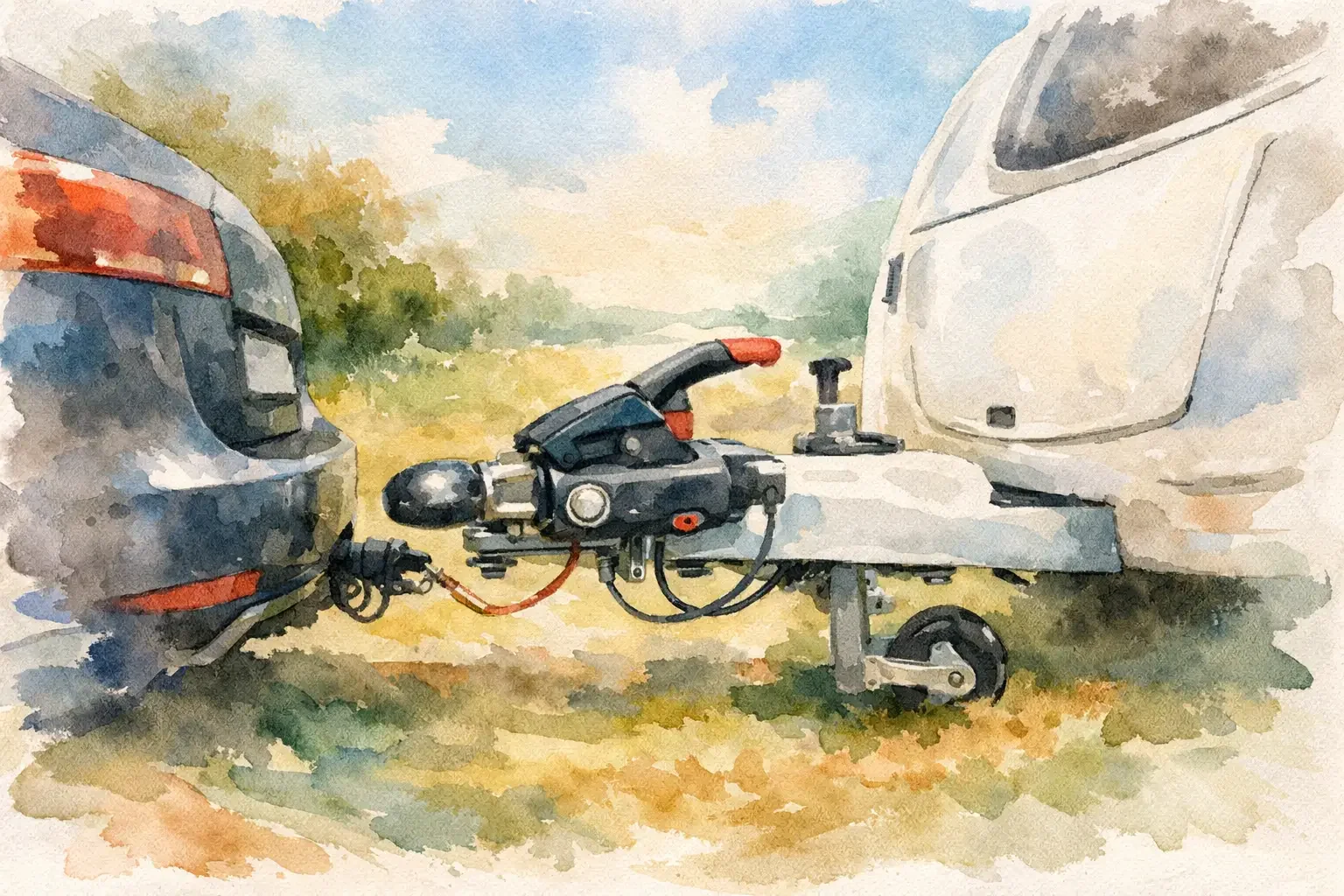
Caravan Stabiliser Hitch Review for Beginners
A coach overtakes, the air shifts, and your caravan gives a small nudge through the steering wheel. That is usually the moment a new owner starts wondering whether the stabiliser hitch is doing anything at all. In this caravan stabiliser hitch review for beginners, the short answer is yes - but it is not a magic anti-snake button, however reassuring the sales brochure may look.
A stabiliser hitch is one of the most worthwhile bits of towing equipment fitted to many modern caravans. Used properly, it makes the outfit feel calmer and less fidgety, particularly in crosswinds, on uneven road surfaces and when larger vehicles pass. It cannot correct bad loading, an unsuitable tow car or excessive speed. Think of it as useful support for a sound towing setup, not a substitute for one.
What a caravan stabiliser hitch actually does
A standard coupling allows the caravan to pivot freely on the towball. A stabiliser hitch adds friction at that point, normally with friction pads pressed against the towball. That friction resists sudden or repeated side-to-side movement between car and caravan.
In ordinary driving, the difference is often subtle rather than dramatic. The caravan still follows the car. You can still feel wind, cambers and ruts. What tends to change is the amount of small, repetitive movement reaching the driver. Instead of needing a tiny steering correction after every lorry passes, the whole outfit often settles sooner.
That is why a good stabiliser is best judged over a few journeys, not by expecting a theatrical moment on the first roundabout. Calm is rather the point. If it feels as though it has nothing exciting to report, that is generally good news.
Most UK caravans use a stabiliser coupling such as an AL-KO-style unit, although there are different designs and older caravans may have a separate stabiliser device. The principle is similar, but always follow the instructions for the specific hitch and towball combination you have. Caravan fittings have a remarkable ability to look interchangeable right up until they are not.
Caravan stabiliser hitch review for beginners: the real benefits
For a beginner, the main benefit is confidence without complacency. Towing can initially feel busy because every movement behind the car seems important. A stabiliser helps take the sharp edge off normal disturbances, so you have more room to drive smoothly rather than grip the wheel as though it has personally offended you.
It is particularly noticeable when the caravan is correctly loaded and matched sensibly to the tow car. On a motorway, a passing coach or articulated lorry may still create a push-pull sensation, but the caravan should remain composed rather than beginning a continuing weave. On rural roads, the hitch can reduce the little knocks and twitches caused by broken edges, undulations and changes in road surface.
There is another benefit that is less often mentioned: it encourages a sensible towing routine. You must couple carefully, check the hitch indicator where fitted, apply the stabiliser handle and make sure the breakaway cable is attached correctly. That small sequence helps turn departure checks into habit. The device is not teaching you to tow, of course, but good equipment can make good habits easier to build.
The trade-off is that stabilisers can make coupling and uncoupling slightly more deliberate. The handle needs operating, the towball must be suitable and clean, and worn pads need attention. This is hardly a hardship, but it is one more job before the kettle can be switched on at the other end.
What it will not fix
The most unhelpful myth around stabiliser hitches is that fitting one makes any outfit safe. It does not. If a caravan begins to snake seriously, the cause may be loading, weight distribution, speed, tyre condition, a mechanical issue or an awkward combination of several factors. A friction stabiliser may reduce the likelihood or severity of minor instability, but it cannot repeal physics because a shiny lever has been pulled down.
Start with the basics. Load heavy items low down and close to the caravan axle. Avoid loading the rear with chairs, awnings, crates and everything else that did not fit in the house. Stay within the legal weights for the car and caravan, check tyre pressures when cold, and ensure the caravan noseweight is within the limits of both the car and hitch.
If the caravan feels persistently unsettled, do not simply buy another gadget and hope for the best. Stop, reassess the load and check the outfit. If instability develops while driving, ease off the accelerator smoothly, keep the steering straight where it is safe to do so, and avoid sudden braking or sharp steering inputs. Get the combination checked before continuing. That is calm decision-making, not drama.
The towball detail beginners often miss
Stabiliser hitches rely on clean friction surfaces. The towball should be the correct type for the hitch and free from paint, grease, rust, dirt and old lubricant. This catches people out because conventional towballs are often greased, whereas many friction stabiliser hitches specifically require a dry, clean ball.
Do not guess. Your caravan handbook will state what is required. Using grease where the manufacturer says not to can reduce the stabilising effect and contaminate the friction pads. Cleaning contaminated pads may be possible in some cases, but replacement is sometimes the sensible answer.
Look at the towball before every journey. It takes seconds. If it is greasy because the car also tows a trailer with an ordinary coupling, clean it before hitching the caravan. A removable towball can make this easier, but it is not essential. The important thing is following the requirements of the stabiliser you actually own, rather than a confident comment remembered from a campsite conversation.
Coupling it correctly
The exact sequence varies slightly, but the usual approach is straightforward: raise the caravan hitch above the towball, reverse the car into position, lower the coupling until it locks, check the coupling indicator, attach the breakaway cable correctly, fully raise the jockey wheel, then apply the stabiliser handle.
Before setting off, try to lift the caravan hitch with the jockey wheel very slightly. If the car rises with it, the coupling is properly engaged. Then lower the wheel again and stow it. This simple check is far more valuable than listening for a satisfying clunk and assuming the job is done.
Avoid forcing the stabiliser handle. If it will not engage normally, stop and investigate. The coupling may not be seated properly, the towball may be unsuitable, or the pads may need inspection. Brute force is rarely the secret technique missing from the handbook.
How it feels on the road
A stabiliser hitch should not make the caravan feel glued to the road. Nor should it remove every sensation from the rear of the car. You are still towing a large, tall box containing your holiday possessions and, if you are honest, too many tins.
A well-set-up outfit generally feels settled, predictable and easy to place. You may notice the greatest difference during motorway overtakes, in gusty conditions and on roads that encourage small repeated movements. It is less about eliminating movement and more about preventing normal movement from building into a nuisance.
If you are new to towing, choose a quiet first route and give yourself time. Practise gentle acceleration, early braking and wide, unhurried turns. The stabiliser will be there doing its job, but your smooth inputs are still the most effective stabiliser in the whole arrangement.
Maintenance and signs it needs attention
Stabiliser hitches are not fit-and-forget. Check the friction pads and hitch mechanism at the service intervals in the manufacturer guidance, and ask your caravan service engineer to inspect them if you are unsure. Some hitches have wear indicators, which are useful, though they are not a replacement for a proper look.
Watch for a handle that becomes unusually difficult to operate, visible damage, a contaminated towball, excessive corrosion or a hitch that does not couple cleanly. Also check that the bellows, breakaway cable and electrical connection are in good condition. None of this is glamorous. Neither is waiting beside a wet lay-by for recovery.
For most beginners, a properly maintained stabiliser hitch is a reassuring and genuinely useful part of the towing package. Give it a clean towball, sensible loading and a smooth driver, and it will quietly help your caravan behave like the well-mannered travelling companion you hoped it would be.
A Better Caravan Community
TalkWrench is a calmer place where caravanners share real experience without the shouting matches. Practical answers, friendly people, no drama.
Practical tips. No noise.
Straight to your inbox.
Join thousands of caravanners getting calm, useful advice every week — no scare stories, no endless gear lists. Just the good stuff.