
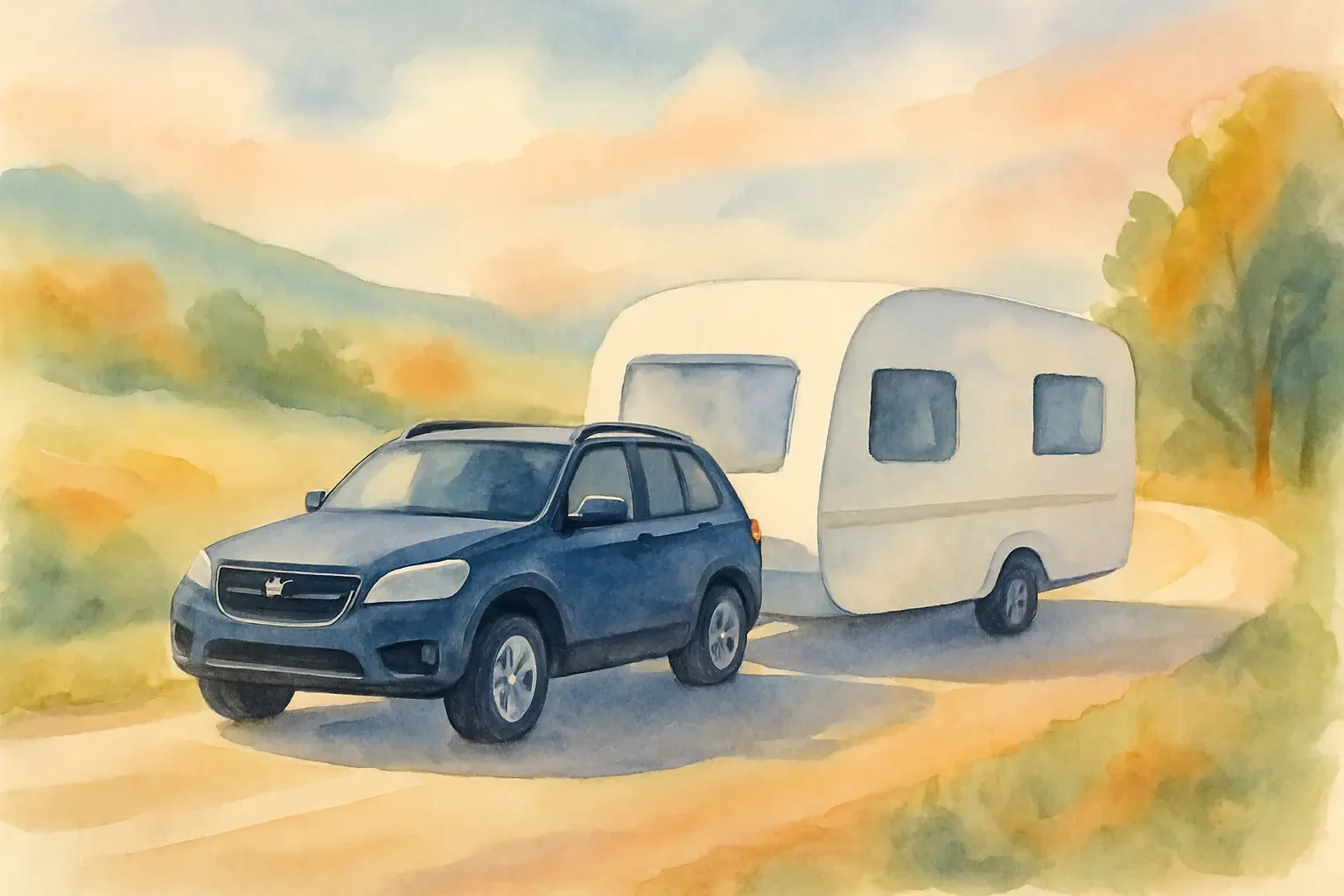
Caravan Towing Confidence — What Actually Helps
You know the moment. You’ve hitched up, done the checks twice (because of course you have), and you’re rolling out of the drive feeling oddly proud - right up until the first roundabout, the first gust of wind, or the first lorry that thunders past as if you’re not there.
Towing anxiety isn’t a character flaw. It’s a normal response to doing something with real consequences while half the internet shouts conflicting “rules” at you. Real confidence comes from understanding what actually affects stability and control, then building a repeatable routine that stops your brain trying to solve everything at 50 mph.
Caravan towing confidence advice that start before you move
Confidence is mostly earned before the tyres turn. Not because towing is mystical, but because the big wobbles people fear usually come from basic setup errors, not bad luck.
The first confidence lever is legality and weights. If you’re even slightly unsure about your car’s towing limit, the caravan’s MTPLM, and what you’re carrying, your mind will keep tapping you on the shoulder mid-drive with a cheery: “Are we sure this is allowed?” That’s not a relaxing passenger.
Aim for clarity rather than perfection. Check your car’s plated limits and handbook towing limit, confirm the caravan’s MTPLM, and have a realistic idea of your loaded noseweight and overall load. You don’t need a spreadsheet that would impress NASA, but you do need enough certainty that you’re not guessing.
Loading is the second lever, and it’s where confidence often falls apart because advice becomes oddly religious. The principle is simple: heavy items low down and as close to the axle as practical, with nothing hefty right at the back trying to act like a pendulum. After that, it depends. Some caravans have storage where it’s convenient rather than ideal, and you’ll adapt. What matters is that you know what you’ve put where, and you can keep it consistent trip to trip.
Noseweight is the third lever. Too light and the outfit can feel skittish; too heavy and you overload the car or upset the handling. People love throwing out a single “magic” figure, but the sensible target is within both the car and caravan limits, and then you tune it based on how your outfit feels. If you can measure it (even occasionally) you remove a huge chunk of uncertainty.
Finally, do the boring checks in the same order every time. Not because you’re trying to become a military unit, but because routine stops you second-guessing later.
Hitching without drama: small habits that prevent big nerves
If hitching feels stressful, it tends to colour the whole trip. The trick is to make it repeatable.
Give yourself time and space. Rushing is the main ingredient in most hitching mistakes, and it’s rarely because you’re disorganised - it’s because you’ve accidentally scheduled yourself to leave at the same time as you’d normally still be hunting for the other shoe.
Use a consistent “walk round” that includes the coupling, breakaway cable (correctly attached to a dedicated point, not looped lazily round the towball), jockey wheel fully up, steadies up, corner steadies locked, lights tested, and a quick look at tyres. You’re not looking to impress anyone. You’re looking to remove surprises.
Then set mirrors properly. If you’re using extension mirrors, take the extra minute to get them stable and aligned so you can see down the side of the caravan and a slice of lane beside it. Confidence comes from information. Bad mirror setup is basically volunteering for uncertainty.
Get comfortable with the feel of the outfit
Most people who say “I just don’t feel confident towing” actually mean “I don’t know what ‘normal’ feels like”. That’s fixable.
In the first few miles, let the outfit talk to you. Is the steering lighter? Does the car take longer to settle after a direction change? Do you feel a gentle push as the caravan follows? That’s all normal. The aim is not to make it feel like solo driving - it won’t. The aim is to recognise the new baseline so you don’t interpret every sensation as danger.
If you can, practise in a quiet industrial estate on a Sunday. Do a few big loops, gentle turns, controlled braking from 30 mph, and some slow-speed manoeuvres. You’re teaching your brain that towing is a skill you can repeat, not an event that happens to you.
Speed, spacing, and why calm beats brave
Speed is the most obvious confidence lever, and also the one most likely to attract unhelpful commentary. The reality is simple: a lower, steady speed gives you more time to react, reduces sway risk, and makes everything feel less frantic.
In the UK, remember the different speed limits for towing - and also that “legal” and “comfortable” aren’t always the same. If 50-55 mph on a dual carriageway feels calmer for your outfit and conditions, that’s not you being timid. That’s you making a judgement call.
Spacing matters even more. You’re heavier, longer, and you need more room to slow down smoothly. Leaving a big gap isn’t an invitation for every hatchback to move into it (although some will try). It’s a safety margin you control. Smooth braking is confidence-building because it keeps the caravan settled and stops that unpleasant “push” feeling.
Handling roundabouts and bends without the white-knuckle grip
Roundabouts are where many new towers feel exposed. Everything is moving, lanes are tight, and you’re conscious of the extra length behind you.
Two things help. First, approach slower than you would solo, and pick a gear that lets the car pull cleanly without rushing. Second, focus on being smooth rather than fast. Sudden steering inputs are what start the caravan moving around. A steady line and gentle throttle keep the outfit composed.
On bends, the same rule applies. Enter a touch slower, hold a stable throttle, and avoid mid-bend braking if you can. It’s not that braking is forbidden - it’s that stability is easier when weight transfer is predictable.
Wind, lorries, and other things you can’t control
Crosswinds and passing HGVs are the classic confidence killers, mostly because they feel like the caravan has its own opinions.
A gust or a lorry passing will often create a brief tug or push. The confident response is boring: keep a steady course, don’t over-correct, and ease off the accelerator slightly if needed. Over-steering is what turns a small movement into a bigger one.
If conditions are truly rough, it’s fine to adjust your plan. Slow down, take a break, or wait it out. There’s no prize for arriving with sweaty palms. Towing confidence includes knowing when not to force it.
Reversing: confidence comes from one good method
Reversing is where people collect most of their towing folklore, usually delivered loudly by someone who “used to drive artics”. Helpful.
Pick one method and stick to it. The simplest for many is: hands at the bottom of the steering wheel, small inputs, and plenty of pauses to straighten up. The goal is not to reverse in one smooth cinematic shot. The goal is to stay in control.
If you have a mover, use it without guilt. A mover isn’t a moral failure. It’s a tool. There are situations where reversing with the car makes more sense (long drives on site roads, narrow approaches), and situations where the mover reduces stress and prevents scrapes. Choose the one that keeps you calm and accurate.
And if you can, practise somewhere quiet with cones (or the classic British substitute: two recycling boxes you’re willing to emotionally detach from). Ten minutes of practice beats ten hours of reading opinions online.
When the outfit feels unstable: what to do, and what not to do
If you ever feel the caravan starting to sway, the first job is to not escalate it.
Avoid accelerating to “pull it straight” and avoid sharp steering corrections. Instead, hold the steering steady and ease off the accelerator smoothly. If your car has a trailer stability programme, let it do its thing. If the sway doesn’t settle quickly, slow down gently and find a safe place to stop and reassess your loading, noseweight, tyre pressures, and whether you’re simply battling conditions that make today a poor day for speed.
This is also where realism matters. A correctly loaded, correctly matched outfit driven sensibly should feel stable most of the time. If you’re regularly feeling on-edge, treat it as useful feedback rather than something to “get used to”.
The confidence routine: make it repeatable, not perfect
Most towing confidence comes from consistency. When you do the same checks in the same order, load the caravan in a familiar way, and drive with the same calm habits, your brain stops scanning for disasters.
A good routine is personal. Some people like a written checklist; others like a set sequence they can run through automatically. What matters is that it catches the big errors: coupling secure, breakaway cable correct, electrics connected and tested, jockey wheel and steadies up, lockers shut, load secure, mirrors set, tyres looked at.
If you want a calmer pathway through the noisy topics - weights, matching, and the stuff that tends to generate more heat than light - CaravanVlogger exists for exactly that sort of steady, experience-led clarity.
Confidence is allowed to be quiet
You don’t need to feel fearless to be competent. You just need to feel prepared, informed, and in control of your decisions.
The nicest moment with towing isn’t when you finally stop feeling anything at all. It’s when you realise you’ve been driving for an hour, the outfit feels settled, and your attention has shifted from worry to the actual point of the trip - where you’re going, who you’re going with, and what kettle is getting first use when you arrive.
This page sits alongside:
Together, they explain why towing behaviour changes — without turning it into a science exam.
Where next?
If nose weight was worrying you, the next useful read is:
👉 What Actually Causes Snaking?
It ties everything together.
Back to “Towing Without The Panic”
Need clearer caravan answers?
TalkWrench is where caravan questions get calm, experience-based explanations — without the noise, arguments, or guesswork.