
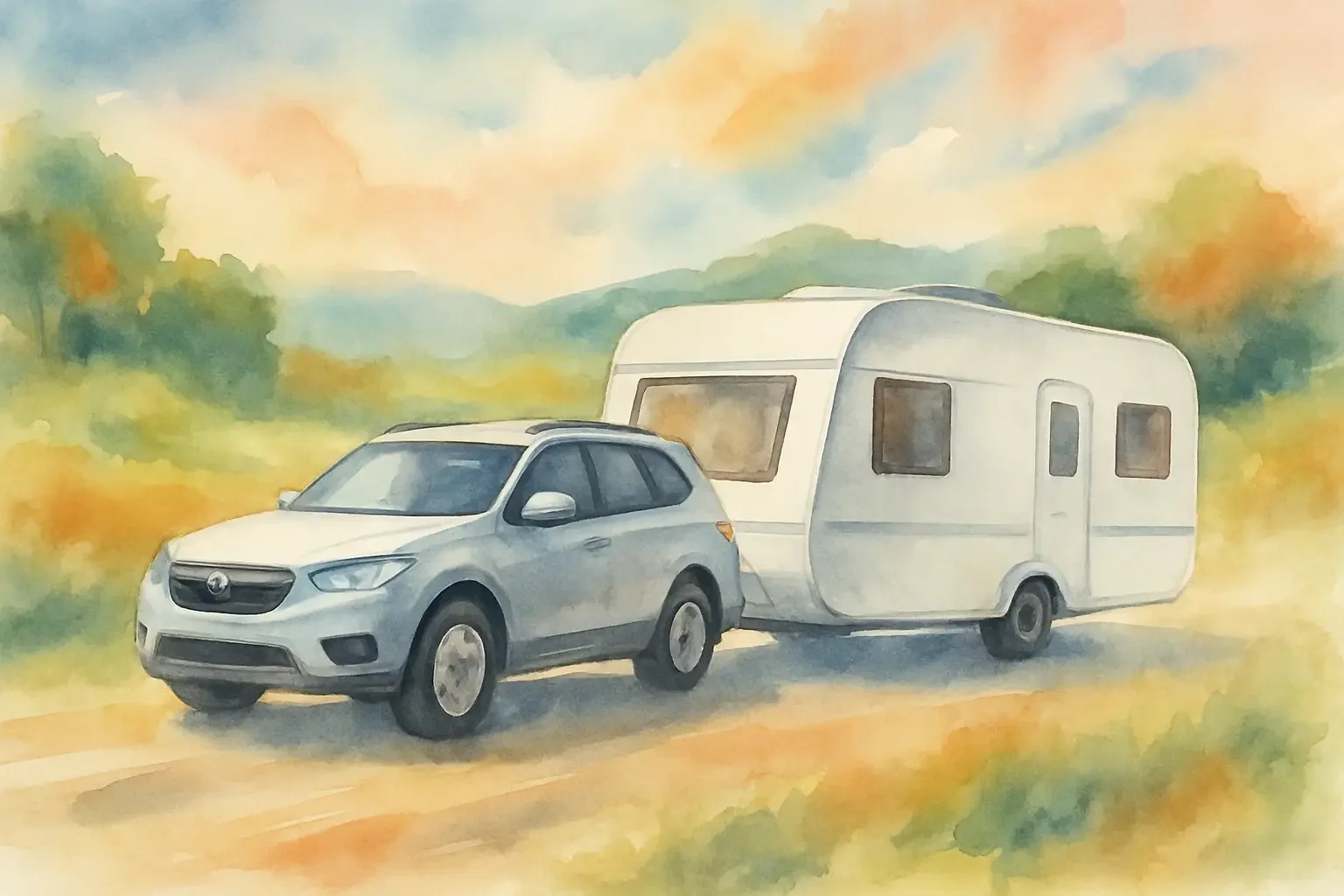
Tow a Caravan Safely Without the White Knuckles
That first pull-away with a caravan behind you is oddly loud. Not the engine - your brain. Every clunk feels like a catastrophe, every gust of wind a personal insult, and suddenly you’re scanning the mirrors like you’re looking for a missing child in Tesco.
The good news is this: safe towing isn’t about being brave or buying every gadget in the shop. It’s mostly about getting a few fundamentals right, then driving like a grown-up who has accepted that arriving ten minutes later is a bargain.
How to tow a caravan safely starts before you move
Most towing problems don’t begin on the A1. They begin on the driveway, when we rush, guess, or assume “it’ll be fine”. If you want confidence, your best friend is a repeatable routine.
Weights are the unsexy foundation. In the UK, the legal bits are tied to your car’s limits and your licence entitlement, and the practical bits are tied to stability and braking. If you’re not sure what your car can tow, don’t rely on a forum memory of someone else’s spec. Check your car’s handbook or the VIN plate data and the caravan’s plate. If you’re close to the limits, it doesn’t mean you can’t tow - it means your margin for sloppy loading and over-optimistic driving gets smaller.
The other pre-move job is being honest about the trip. A weekend on a local site with empty roads and fair weather is one thing. A cross-country tow in heavy rain, with a roof box, bikes, and a car full of passengers is another. “It depends” is not a cop-out - it’s how safe decisions actually work.
Load for stability, not for your back
People overcomplicate loading with rules carved into stone tablets. Here’s the calmer version.
Aim for a sensible noseweight within both the car and caravan limits. Not “as high as possible”, not “as low as possible”. Within limits, a stable outfit generally benefits from enough downward force to keep the hitch planted, but pushing beyond any limit is a hard no. Measure it rather than guessing by how much your suspension squats.
Then think about where mass sits. Heavy stuff wants to be low down and close to the axle line, so it can’t swing the caravan like a shopping trolley with a wonky wheel. Putting all the weight at the very back is the classic way to invite snaking. Putting it all at the very front can overload noseweight and change the way the car steers and brakes.
Also, secure it. A kettle that becomes a projectile inside a cupboard isn’t just noisy - it can shift weight mid-journey. You don’t need to wrap everything like it’s going to space. You just need to stop big items moving.
Tyres, pressure, and the boring bits that save you
Check tyre condition and pressures on both car and caravan before you set off, when the tyres are cold. Under-inflated caravan tyres are a quiet confidence killer - they build heat and they don’t behave predictably.
While you’re there, look for obvious damage, check wheel nuts if you’ve had wheels off recently, and confirm lights. If you’ve ever discovered a dead indicator only once you’re already blocking a junction, you’ll know why this matters.
Hitching up without the drama
Safe towing depends on a properly connected outfit. The tricky part is that hitching feels “done” when it looks connected. It’s only done when it’s actually locked, supported, and checked.
Get the hitch height roughly level, lower onto the towball, and make sure the coupling has latched. Do a proper pull-up check: jockey wheel down slightly so the caravan tries to lift the back of the car. If it lifts the car, you know the coupling is taking the load. If it doesn’t, something is wrong and you fix it now, not at 40 mph.
Attach the breakaway cable correctly, to a proper attachment point - not looped around the towball like a decorative bracelet. The point is for it to pull the caravan brakes on if the worst happens. If it’s attached wrongly, you’ve basically got an expensive piece of string.
Then electrics: plug in, check lights, and if you’ve got a reversing camera or towing mirrors, set them before you move. Finally, stabiliser (if fitted) engaged, jockey wheel fully up, corner steadies raised, handbrake released, and any loose chocks removed. Yes, this is the part where people forget one thing, every time. That’s why a routine beats a memory.
Driving technique: calm, early, and slightly boring
This is where most of the myths live. Towing safely isn’t about “dominating” the road. It’s about giving yourself time and space so nothing becomes urgent.
Pull away gently and let the outfit settle. You’ll feel the extra mass immediately, especially on hills and when joining faster traffic. Build speed progressively. Your goal is to avoid sharp inputs - sharp steering, sharp acceleration, sharp braking - because the caravan will always react a beat after the car.
Leave bigger gaps than you think you need. Not because you’re timid, but because braking distances are longer and you can’t do the little last-second corrections you might do solo. If you’re being tailgated, you can’t control them, but you can control your own buffer ahead.
Corners, roundabouts, and the art of being wide enough
Caravans cut in. It’s not a character flaw, it’s geometry. Approach turns a touch wider and slower, and watch the caravan wheels in your mirrors. Roundabouts are the same story: take your time, keep the steering smooth, and don’t get bullied into a line you haven’t set up.
If you’re new, choose calmer routes for the first few runs. Motorways and dual carriageways can actually be easier than narrow A-roads with parked cars and surprise bends. The “shorter” route isn’t always the easier tow.
Downhill control without cooking your brakes
On long descents, use engine braking. Select a lower gear earlier than you would solo, so you’re not riding the brakes and building heat. If you smell brakes or feel the car starting to push, that’s your cue to back off and let the drivetrain do more work.
Handling sway and snaking without making it worse
Let’s take the fear out of this one. Sway can happen even to sensible people. The key is how you respond.
If the caravan starts to snake, don’t accelerate to “pull it straight”. Don’t make big steering corrections. The most helpful response is usually to ease off the accelerator smoothly and, if needed, brake gently in a controlled way to reduce speed while keeping the steering as steady as you can. Sudden inputs add energy to the oscillation.
Then, once it’s stable, you ask why. Common causes are too much weight at the rear, too little noseweight, side winds, being passed by a lorry at speed, under-inflated tyres, or simply going faster than conditions suit. Sometimes it’s one thing. Often it’s a small pile-up of little things.
If you’re repeatedly getting sway on the same outfit, treat it as a loading and setup problem first, not a personality test. Stability aids can help in certain cases, but they don’t replace correct weights, tyres, and speed.
Reversing and manoeuvring: slow is a skill, not a weakness
Reversing a caravan is not hard because you’re bad at it. It’s hard because it’s a different control problem than reversing a car.
Go slowly, use small steering inputs, and stop early to correct rather than trying to rescue a big angle. If you can, have a helper outside, but agree simple signals before you start. The world’s worst plan is two people shouting different directions while you guess which one is “left”.
If your site has a queue behind you, ignore the pressure. They can wait. You’re the one paying for the pitch, and you’re the one who will be explaining a dented rear panel later.
A quick word on tech and accessories
Towing mirrors that give you a clear view down both sides of the caravan are a practical win, not a fashion statement. Tyre pressure monitoring systems can also be genuinely useful, especially for catching a slow leak before it becomes a mess.
But tech doesn’t do the thinking for you. A stabiliser hitch, sway control, or fancy camera won’t fix an overloaded caravan, a wrong noseweight, or an impatient right foot. Spend money if it removes stress or improves visibility - just don’t buy it as a substitute for the basics.
Build confidence like you build any skill
If you’re nervous, practise in a quiet car park or an industrial estate on a Sunday. Do a few loops, a few gentle stops, a couple of controlled reverses. Confidence comes from familiarity, not pep talks.
And if the internet is giving you whiplash with contradictory advice, stick to sources that explain the why, not just the rule. CaravanVlogger has a lot of calm towing and weights guidance at https://caravanvlogger.co.uk that’s designed to reduce the noise rather than add to it.
The most reassuring truth about how to tow a caravan safely is that it’s not a secret art. It’s a handful of checks, a sensible load, and driving that leaves room for reality - wind, hills, other people’s impatience - without letting any of it rush you.
Where next?
If this page raised questions (that’s normal), the next helpful reads are:
👉 Caravan Nose Weight Explained (Without the Maths)
👉 What Actually Causes Snaking?
Both are part of Towing Without the Panic.
Need clearer caravan answers?
TalkWrench is where caravan questions get calm, experience-based explanations — without the noise, arguments, or guesswork.