
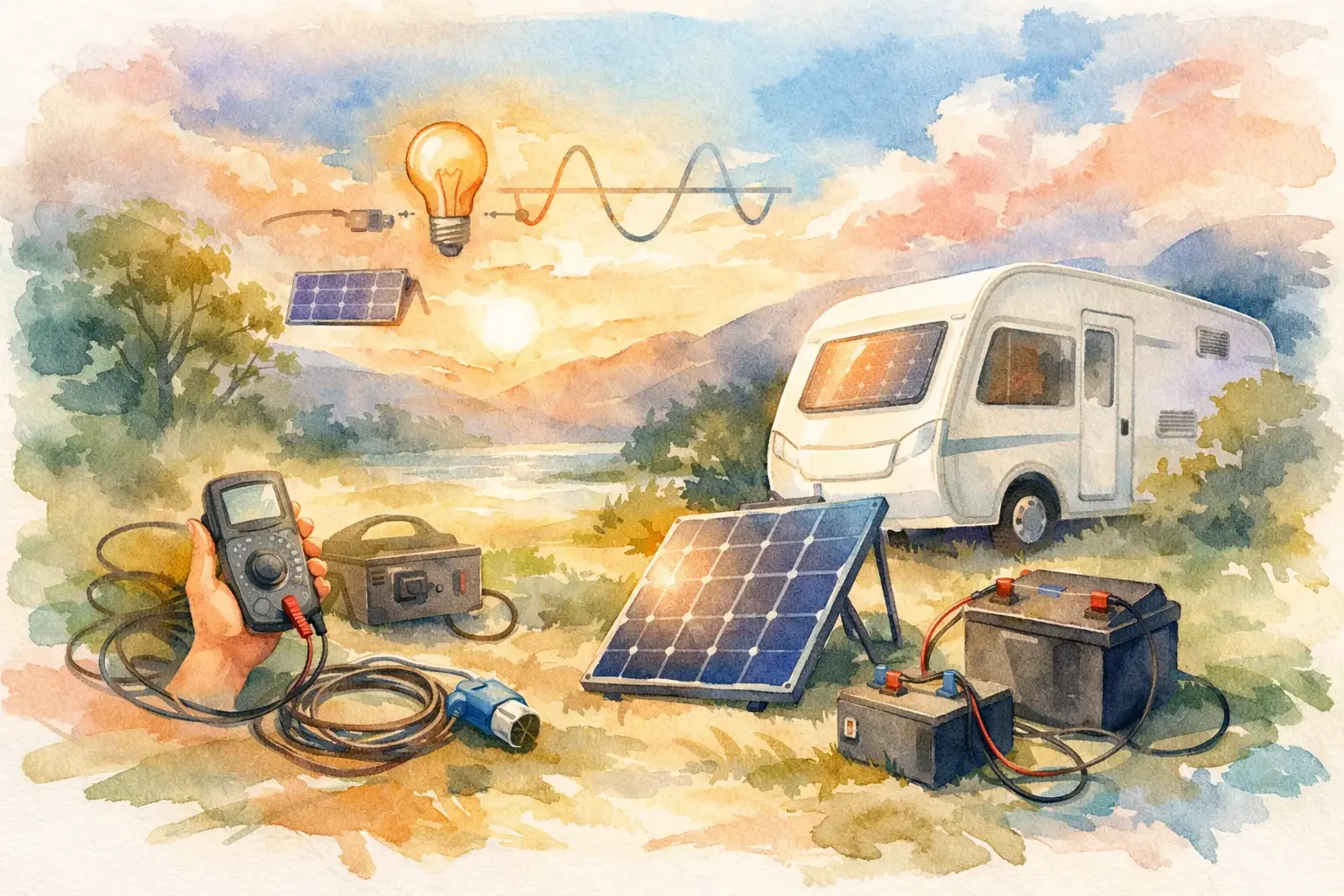
Caravan Electrics for Beginners: A Clear Guide
Practical tips. No noise.
Straight to your inbox.
Join thousands of caravanners getting calm, useful advice every week — no scare stories, no endless gear lists. Just the good stuff.
The first time you plug a caravan into a bollard, it can feel faintly as though you are about to launch a small spacecraft. You are not. This caravan electrics for beginners guide is about understanding what is doing what, spotting the things that genuinely matter, and leaving the rest of the jargon where it belongs: in a forum argument from 2014.
Most caravan electrical systems are straightforward once you separate them into two parts. One runs from the leisure battery at 12V. The other comes from the site mains supply at 230V. They work alongside each other, but they are not interchangeable, and treating them as such is where confusion begins.
Caravan electrics for beginners: start with two systems
The 12V system is your caravan's low-voltage side. It normally supplies the interior lights, water pump, toilet flush, control panel, some USB sockets and, depending on the caravan, a few other small items. When you are not connected to mains electricity, this is the system keeping the basics alive.
The 230V system is the domestic-style mains side. Once connected to an electric hook-up, it runs things such as the mains sockets, microwave, heating element in the water heater and often the fridge's mains setting. It also allows the onboard charger or power supply unit to charge and support the leisure battery.
That last point catches people out. Being on hook-up does not mean every 12V item is suddenly running directly from the bollard. The caravan's electrical unit manages the relationship between the mains supply, battery and 12V circuits. Exact behaviour differs between makes and ages of caravan, so the handbook is useful here. It is not glamorous reading, but neither is discovering your pump has stopped halfway through washing up.
Electric hook-up without the drama
A caravan hook-up lead connects the site's supply bollard to the caravan inlet. Use a proper caravan-rated orange lead in good condition, with suitable weatherproof connectors. The orange cable is not a legal requirement because orange is magical, but it is highly visible and intended for the job.
Before connecting, inspect the cable and plugs. Look for cuts, crushed sections, loose pins, heat marks or a damaged flap on the caravan inlet. If anything looks suspect, do not persuade yourself it will be fine for one weekend. Electricity is impressively indifferent to optimism.
With the caravan's mains supply switched off, connect the lead to the caravan first and then the bollard. Unwind the cable fully, especially if you expect to use several mains appliances. A coiled cable can get hot under load. Keep joins off wet ground where possible, route the lead so nobody is likely to drive over it, and avoid stretching it across a route people will walk at night.
Once connected, switch on the bollard and then the caravan's mains unit. Check that the relevant indicators show a supply and test the RCD using its test button, following the caravan handbook. The RCD is there to disconnect the supply quickly if it detects a fault. If it will not reset, or trips repeatedly, stop trying to win a staring contest with it and investigate the cause.
Do not use improvised adapters, damaged extension leads or household multiway blocks outside. Likewise, do not attempt repairs inside the 230V consumer unit unless you are competent and qualified to do so. Changing a plug on a suitable cable is one thing; modifying a caravan mains installation is quite another.
Know what a site supply can provide
Not every pitch gives the same amount of power. A UK site may offer anything from a modest supply to a more generous one, and the limit matters. A kettle, fan heater, microwave and electric water heater can soon ask for more than the bollard is willing to provide.
You do not need to perform calculations every time you make tea. Just avoid running several high-wattage appliances together, particularly on a lower-amp pitch. If the bollard trips, reduce the load before resetting it. Repeatedly resetting a breaker without changing anything is not fault-finding. It is just pressing a button with feeling.
The leisure battery: useful, not invincible
Your leisure battery is designed to supply steady power to caravan equipment. It is different from a car battery, which is mainly built to deliver a large burst of energy to start an engine. Fit the type and capacity recommended for your caravan and how you tour. A couple using lights and a pump for occasional off-grid stops has different needs from a family running a motor mover, television and several charging devices.
Battery capacity is commonly expressed in amp-hours, but a bigger number is not automatically the right answer. Larger batteries cost more, weigh more and need suitable charging. For most beginners, a healthy, correctly secured battery of sensible capacity is better than buying the largest one that will physically squeeze into the locker.
Check the terminals are clean, tight and protected by their covers. Secure the battery properly in its box or tray. A heavy battery moving about while towing is a poor idea electrically and mechanically.
A battery can appear charged shortly after coming off mains, then lose voltage under use. That is why a basic battery monitor or multimeter is handy, though neither is a crystal ball. Voltage gives a useful indication, but it is best read after the battery has rested rather than while the charger is working hard or a pump is running.
If you store the caravan for long periods, follow the battery and caravan manufacturer's advice on charging and isolation. Some owners leave a maintained supply connected where appropriate; others remove and maintain the battery separately. It depends on the caravan, charger and storage arrangement. What matters is avoiding a battery sitting flat for months.
Fuses, breakers and the control panel
A fuse protects a 12V circuit. If a light, pump or toilet flush stops working, the relevant fuse is one of the first things to check. Replace it only with the same type and rating. Fitting a larger fuse because the original blew defeats the protection and can turn a small fault into an expensive wiring problem.
Circuit breakers and the RCD protect the 230V side. A breaker usually responds to overload or a fault on one circuit, while the RCD looks for current going somewhere it should not. That could include a faulty appliance, damaged cable or moisture-related issue.
Your caravan's control panel may show battery voltage, water levels, mains connection and pump status. Useful, certainly, but do not assume every reading is laboratory-grade precision. Treat it as a guide, then use common sense. If the panel says the fresh water tank is full but the pump is coughing air, believe the pump.
Solar panels and chargers: helpful, with limits
Solar can make off-grid touring more relaxed by putting charge back into the leisure battery during daylight. It is particularly useful for light, steady use: alarms, control systems, lighting, charging phones and keeping a healthy battery topped up.
It will not reliably support unlimited power use, especially in a British winter, under trees, or when the family has decided every device needs charging at once. Solar output varies enormously with season, shade, panel size and the controller setup. Consider it a helpful contributor rather than a tiny power station on the roof.
The same applies to USB sockets and inverters. USB charging is usually modest and sensible. An inverter that creates 230V from the battery can be useful for selected equipment, but high-power appliances flatten batteries quickly. If you need mains-level heat, a campsite bollard is generally less dramatic than asking a leisure battery to boil a kettle.
A calm way to find an electrical fault
When something stops working, begin with the simplest explanation. Is the caravan connected to hook-up? Has the bollard tripped? Is the battery isolator on? Is there water in the tank, if the issue is the pump? Has a switch been knocked off on the control panel?
Then narrow it down. If every mains socket is dead but 12V lights work, focus on the hook-up, RCD and mains breakers. If lights and pump are both dead off-grid, check the battery connection, main 12V fuse and battery isolator. If one item has failed, check its own switch, fuse and connections before assuming the whole caravan has developed a personality disorder.
Unplug portable appliances one at a time if an RCD trips, then try resetting it. A faulty toaster, damp lead or damaged appliance is often the culprit. If the fault persists with everything unplugged, or you see scorching, smell burning, find melted plastic or get repeated unexplained trips, isolate the supply and get a competent caravan electrical technician involved.
Small habits that prevent bigger problems
A quick check before each trip saves most electrical bother. Inspect the hook-up lead, make sure the battery is secure, check the battery terminals, and confirm lights, pump and charger are behaving normally. Keep a few correctly rated spare 12V fuses in the caravan, along with a torch and the handbook.
Be particularly alert after winter storage or a very wet spell. Damp, corrosion and rodent damage have no respect for your plans. Let the caravan dry properly, inspect accessible cables and lockers, and do not ignore a breaker that has suddenly become temperamental.
The aim is not to become the campsite's unpaid electrical consultant. It is simply to know the difference between a flat battery, a blown fuse and a problem that deserves professional help. Once that is clear, caravan electrics become another ordinary part of touring - rather like levelling, but with fewer opinions offered from three pitches away.
A Better Caravan Community
TalkWrench is a calmer place where caravanners share real experience without the shouting matches. Practical answers, friendly people, no drama.